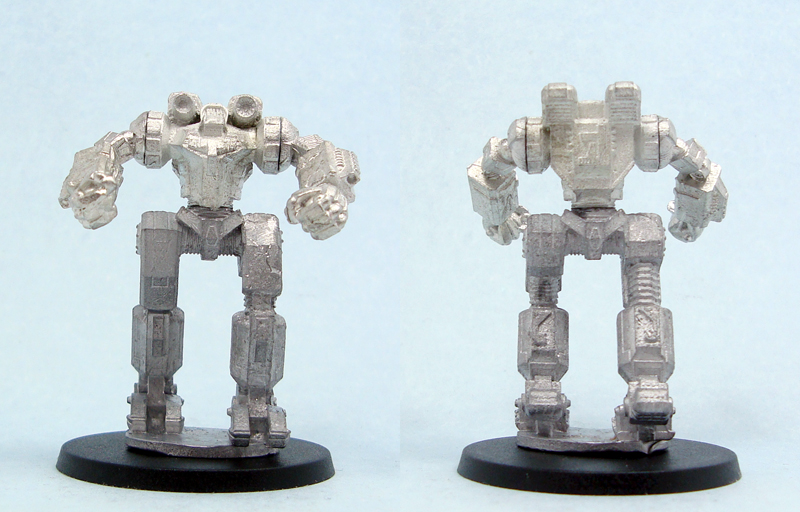
I happened to get up earlier than normal today (6:15 am in fact), and there was such a lovely light in my game room that I snapped a photo of the current state of my Pacific Rim setup. It’s actually an Instagram photo, so I slapped a retro filter on it, and I think it turned out nice. So, here’s a mood piece for you to hopefully enjoy!
Archive for the ‘Sci-Fi’ Category

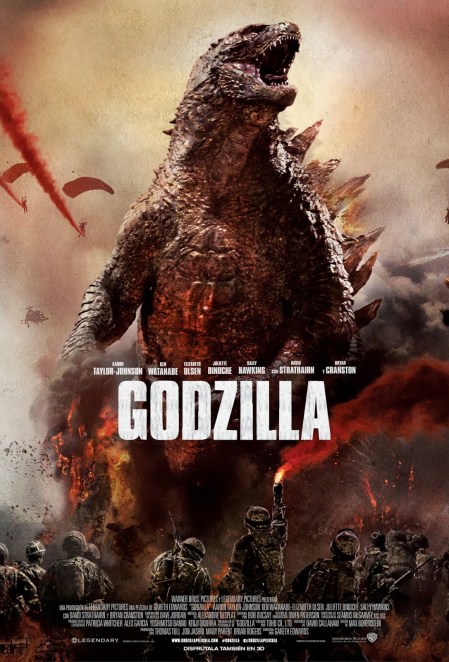
Godzilla (2014) – a review
May 17, 2014
The new Godzilla film has been my most anticipated movie since Fellowship of the Ring, so you can imagine that I had pretty big expectations when I walked into the cinema. I was also excited and a little bit fearful – after all with high expectations comes a high risk of disappointment. Happily enough, I wasn’t let down by the film. I saw the 2D version.
I will try to keep this film fairly spoiler free, but if you are such a purist that you haven’t even watched any trailers, I suggest you stop reading here.
The basic premise of the movie is simple enough. There are giant monsters, they fight each other and mankind gets caught in the middle. However, I like how they’ve managed to keep the film feeling fresh and interesting instead of simply having a two hour CGI slugfest. Luckily, that’s not to say there isn’t a good bit of monster punch-out involved.
Let’s start with the best parts. First of all, the visuals. Godzilla looks very, very nice. The shots of Godzilla and the other monsters wrecking civilization (and there are plenty of those) are excellent. There’s a great sense of scale, and a feeling of weight often missing from CGI. The monsters feel big, heavy and physical as does the destruction they cause. There are some actually beautiful shots in the film, balancing serenity with destruction – an aerial shot of a Navy fleet following Godzilla was a particular favourite, as was Godzilla looming over the lanterns of San Francisco’s Chinatown. There’s plenty of colour and variety of locations in the film, from the islands of the Pacific to the deserts of Nevada.
The sound design was great as well, supporting the visuals. Again, the roars and screeches of the monsters are impressively loud and animalistic, and the theatre rumbled with the roars and the destruction. There is often a nice contrast in the film with calm moments in the audiovisual storm, before the movie again erupts into full-on chaos. My absolute favourite is a sound used a few times in the film, where the destruction of a tower building’s windows creates an ethereal, hauntingly beautiful tinkling. If you’ve seen Gareth Edwards’ previous film Monsters (and you should), there’s a lot of similarity in feel here.
The real beef of the film is of course the combination of monsters and destruction. After all, when you’re going to see Godzilla, you’re going to see a film with monsters destroying stuff. The movie does not disappoint. There is plenty of both available and with loads of variety. You will see the monsters fighting ships, planes, tanks, helicopters and infantry and destroying power plants, trains, skyscrapers and landmarks. There’s even a tsunami thrown in. Godzilla looks a lot like a catastrophe movie, as it should. The monster designs are very nice and things are kept interesting.
I want to dedicate a paragraph to the monsters themselves. Monster choreography in Godzilla is excellent. The battles between monsters look like something out of an awesome David Attenborough -narrated nature document. The monsters look, feel and act real, and mostly they don’t feel like movie heroes and villains, but simply giant, monstrous animals, which helps sell them to the audience. I also liked the fact that despite modern day visuals, they haven’t completely done away with the “man in a suit” feel of Godzilla.
As you might guess, the plot and the human characters don’t particularly shine in the film. Both are adequate for the film, and the plot has a few interesting twists, but let’s face it: in a genre film like this, I’m not going in to see awesome drama, deep characters and an intricate plot. If anything, the film tried to inject too much character and family drama into the film, but it didn’t really work. While it didn’t really fall flat on its face, the end result was still a little meh and felt unnecessary. The same thing plagues pretty much every big apocalyptic film (with the exception of Pacific Rim): the destruction of millions of people is not seen as tragic enough, but there always has to be the story of a family separated by the events. In Godzilla it isn’t as cheesy as several other films (say the god-awful 2012), but the plot device didn’t really work. All the actors turn in a solid day’s work, but there really isn’t anything remarkable on offer. There are a few minor irritations, my personal not-favourite being Ken Watanabe’s Japanese doctor, who should be an expert on the subject but tends to only offer cryptic and dramatic lines in a gruff voice instead of being of any help.
There was an element of environmentalism in the movie, which didn’t feel too forced, nor was it really heavy handed. After all, the Godzilla franchise has always been about radiation and its dangers, so this was perfectly in line with the previous films. In a great avoidance of plausible explanations (which never work in movies like this) it’s simply stated that the monsters thrive and feed on radiation. That’s cool with me.
In a genre movie like this, there’s often a tendency to go with a mass of obvious irritating tropes. Director Gareth Edwards and writer Max Borenstein are obviously quite familiar with these, as the movie often sets up situations like this, and then resolves them in a smart manner. An example is a scene where Godzilla is at Golden Gate bridge, and a courageous bus driver with a bus full of children decides to make a run for it through barricades, tanks and all. As the scene unfolded, I was rolling my eyes, as I knew exactly how it would turn out. Despite the chaotic situation, the heroism of the driver would of course clear all the obstacles previously established, there would probably be a groovy one-liner (“Hold on kids, this is gonna get bumpy!” or something similar) and then off they go. I won’t spoil it for you, but things took a more realistic turn. Things like this had me liking the film a lot. Other favourites included an intelligent, sensible military and its non-crazy, non-murderous commander – both aspects always missing from films like this.
Overall verdict: Godzilla is a nice catastrophe movie, and an awesome giant monster movie. It avoids most pitfalls of the genre and offers a wonderful audiovisual experience. If you go in expecting plenty of character development and an intricate plot, you’ll be sorely disappointed – then again, if that’s what you’re looking for, why on earth would you go see Godzilla? If – like me – you go in expecting to see cities levelled and monsters brawling against each other and the military, you’re in for a treat. Godzilla takes second place in my giant monster top 3, behind Pacific Rim but ahead of Cloverfield.

From the painting desk #27 – Knifehead
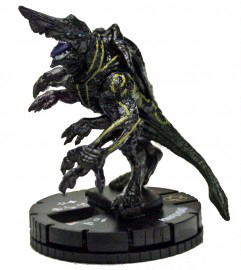
May 3, 2014After painting two jaegers, it was time to tackle a kaiju – they obviously need someone to fight. The first mini in my monster queue was Knifehead, a kaiju from the Pacific Rim movie.
The miniature for it is a Pacific Rim Heroclix one. I forgot to photograph it before painting, but here’s a catalog image:

Painting Knifehead was very different from painting the jaegers. The machines are all straight lines, flat surfaces and clean, bright colours, whereas the kaiju has plenty of texture and organic shapes. This was sort of reflected in my painting of him, as I went for a more irregular layering (read: not as neat), did some drybrushing and used several washes. The end result is very different from the jaegers both stylistically and in feel, and I think it was a good call as it accentuates the whole organic vs. mechanical setup. It also had the benefit of being super fast – the whole mini probably took me a few hours from start to finish.
While I liked the colour scheme of Knifehead and the rest of the kaiju in Pacific Rim, I wasn’t too fond of all the bioluminescent markings, so I did away with them. Instead I went for a blue-green scheme, almost looking like verdigris. In fact, in it’s early stages the model looked a lot like a statue. Again, the tones are very different from the jaegers’. While obviously straying far and white from the canon (schmanon), the end result was worth in my opinion.
As you may know, I like my bases very simple. This time, however, I added a little extra touch in the form of a tiny tank. Instead of completely flipping it over, I just positioned it at an angle that suggests its toylike insignificance compared to the kaiju.
You might have noticed that I seem pretty happy with Knifehead. I am! I was very sceptical of it at first, it being a clix repaint, but I was happily surprised with the end result. There are some awful, awful mould lines there, which I didn’t clean (“Come on, it’s a vinyl clix mini, not worth the hassle, let’s just get it on the table”) but even those don’t show up too badly.

From the painting desk #26 – Seeing red
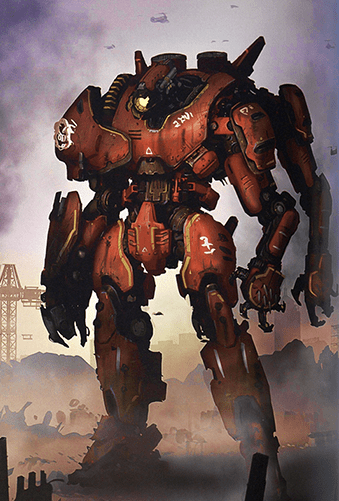
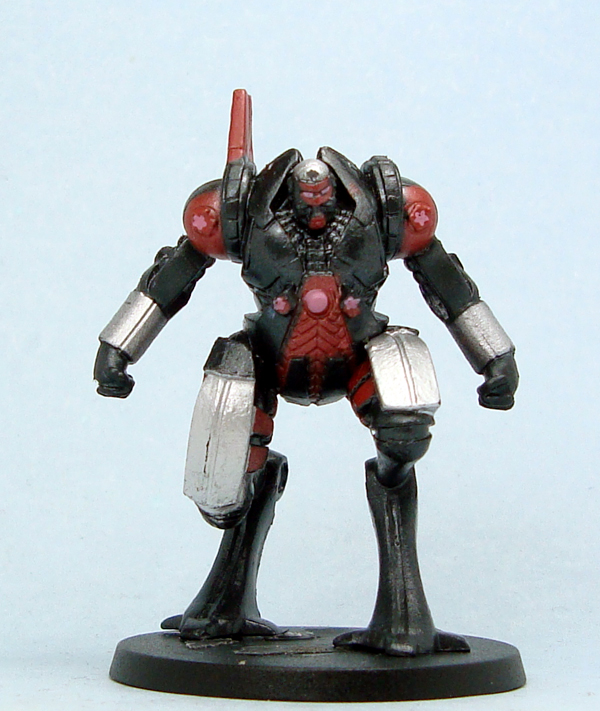
April 30, 2014Another miniature done! Not completely happy with my previous jaeger, I decided to pick a colour I was much more comfortable with – red. I went to work on another Reaper CAV miniature, Hawk. I wasn’t originally too impressed with the mini. I thought it was boring and looked like a generic Transformer. Nevertheless, I started painting it and slowly it grew on me. Now that it’s finished, I’m really happy with it. I spent more time than usual on layering and washes, and I hope it shows!
Inspiration for the colour scheme was another jaeger from Pacific Rim, Crimson Typhoon:

While I would’ve loved to add some fancy freehand detailing, I’m simply rubbish at it. I settled for a few yellow transfers that I painted over a little and added a few dots to make it more interesting, and I think it doesn’t look bad at all. This also stylistically ties it together with the first jaeger I painted. I would’ve loved to paint on some weathering, but in my game setting the kaiju action is only just beginning, and the jaegers have yet to face any – hence no battle damage.
With the first two jaegers painted, it’s time to tackle the first kaiju. Comments and constructive criticism always welcome!

Seaside fun
April 20, 2014Every single miniatures project I’ve ever worked on has suffered its share of setbacks. Often these are a result of rash actions instead of careful planning. With my Pacific Rim game board, it just so happened that I decided that the table would look nicer drybrushed. The smart guy that I am, I tried a sample piece first, then a small corner of the table – both yielded nice results. I then meticulously started drybrushing a large board with a small drybrush, got bored, took a bigger brush to it, didn’t bother to wipe the paint off well enough and ended up with one end of the game board looking like someone did some very poor drybrushing on it.
Next came the question of what to do. As the table wasn’t painted to begin with, I figured that to try and paint the area wouldn’t work – I would have to paint the rest of the table to match. For a brief moment I thought that I might simply cut of the messy end, after all foam cuts easily. This however felt a bit too much. Suddenly, a wild idea appeared!
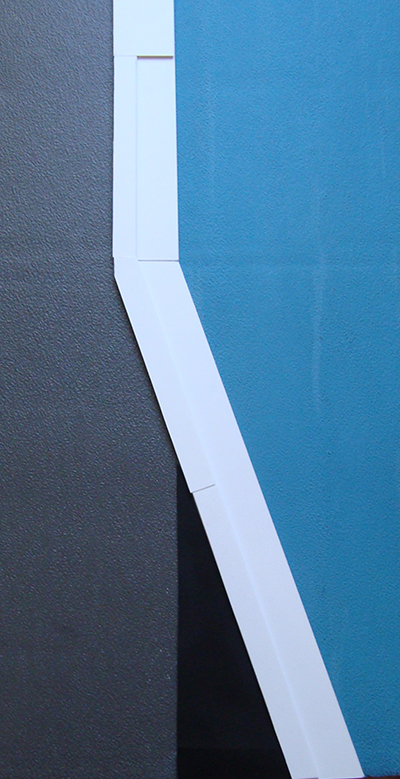
I’d been thinking hard about how to build a seaside on the table. After all, Pacific Rim was all about giant monsters wading out of the sea and into harbours to cause havoc. I had in fact already built a a mock-up of a corner harbour piece out of plasticard and a 1/700 harbour set by Tamiya:
I wasn’t completely happy with it though. A lot of plasticard was wasted in the design, and the corner design was quite limiting. This got me thinking…
Why not just paint the whole end of the table as seaside? The sea would probably be present in all games anyway, and if I didn’t want it for some reason, I could always cover it up. After a quick round of “is this another stupid, rash idea?”-thinking, I went to work, and in a short time I’d painted the end of the table a lovely sea blue, completely covering up my amateurish drybrushing mess.
What about the harbour then? With the sea fixed on the table, I figured the harbour just needed to be something to show where the sea ended and to make the razor sharp coastline a bit more interesting. I kept the main idea of my original harbour design, and simply cut out the strips I needed to make the pier. Wanting something more interesting, I went crazy and cut half of the pier in an angle. I was soooo pleased with myself, until I placed it on the waterline and had a wonderful facepalm moment.
As you may have figured out, I’m not really an engineer. I am however a teacher, and fairly used to improvising fixes for my mistakes. I’ve lately been working with thin mousepads as scenery building material (might do a blog on it), so I just cut out a suitable shape, sprayed it black and voila!
After I paint it to match the pier, it won’t look out of place at all.
Finally, here’s a shot of the harbour with accessories. I think once it’s painted, it will look mighty lovely. The waterline design also means, that if I want to make a sandy beach for example, I can simply cut up mousepads, paint/flock them and lay them over the waterline. Great success!

Genbu by Zenit Miniatures – a review
April 18, 2014I usually spend money on miniatures somewhat sparingly. Or rather, I do consider price quite a lot when making my purchases, although I end up spending lots of money nevertheless. Usually this means I steer away from keywords such as “limited edition” or “boutique” or “for collectors” when it comes to miniatures. Despite this, every now and then I run into something exceptionally interesting that makes me break this rule, and I end up doing a review like the one that follows after this unnecessarily long intro.
As regular readers know, I’m working on a project inspired by the movie Pacific Rim, and thus I’m on the lookout for interesting monsters and giant robots. I visited Salute 2014 a week ago, and I ran into a miniature I’d seen on a news site before and noticed, but which had slipped my mind – Genbu by Zenit Miniatures.
Genbu is a giant, bipedal turtle monster with a snake for a tail, and a part of Zenit Miniatures’ Kensei line. If the concept sounds strange, it has its roots in Chinese (and later Japanese) mythology, and you can read more about it here. Genbu also links directly into the kaiju genre, as it’s undoubtedly the inspiration behind Gamera.
The model comes in seven parts: main torso, shell, tail and four limbs. Normally I would classify this as a nightmare, as I loathe putting metal miniatures together after too many cases of ill-fitting and poorly cast parts requiring literally hours of filing, sanding, cutting, pinning and filling to fit. Zenit Miniatures’ offering was a positive surprise in this respect: the parts fit together well right out of the box. There are joins that need filling, but the model doesn’t appear to require pinning – although you may want to do that with the tail due to the small surface for attaching it. The shell especially snaps into place in a very, very satisfying manner. The one glaring exception to this is the left leg, which I simply couldn’t get to fit well, and will require filling of the joint.
Both the torso and the inside of the shell are hollow, in a smart move to reduce the amount of metal needed. Genbu stands at 45-46mm from soles to top of head, so the model is impressively sized and will work as a giant monster in smaller scales or an ogre sized one in 28mm. There’s a separate square plastic base included, but I mounted mine on a standard 40mm round base.
Sculpting on Genbu is excellent. The sculptor has managed to make a wonderfully characterful giant turtle monster with a gnarled, well textured skin. My only complaint is that the model was originally supposed to be a giant Kappa (see here for original concept art, notice the distinct lack of tail) and as such the Genbu model still has a patch of hair-like texture on top of its head, which doesn’t quite fit in. Even though it can be painted to match the skin, the texture is obviously different. Casting quality is very good, with crisp detail and very little flash. There are some noticeable mould lines but they were quick and easy to clean.
Praise upon praise then, any downsides? Yes. There’s one obvious one that I mentioned right at the start. I bought Genbu at £18.60, and on the Zenit Miniatures site it retails at €19.95. Nice as the model is, that is a hefty price compared to many competitors on the market and will sadly put potential customers off buying it. The model comes with nice packaging – a padded cardboard box with a full colour sleeve around it. I can’t help seeing this as somewhat too much. I don’t know the actual packaging costs, but this grates on me a from an ecological viewpoint as well. I’ve added a photo below showing the actual space the model takes up vs. the size of the box. Then again, the lovely packaging did catch my eye, but it’s a very rare case that I actually by something from a brick and mortar store. If I was mail ordering Genbu, the shipping would add an extra €5 to the price, bringing it to €24.99 and probably keeping me from buying it. Then again, I know a lot of people are used to spending lots more on a single mini than I am, so your mileage may vary!
As usual, I added a size comparison picture. I also added a 28mm miniature, as Genbu is intended to be a large creature in that scale.
Overall verdict: Genbu is pricey, but you do get a very nice model for your money. Good, clean sculpting and very nice casting with (mostly) well fitting parts mean that you won’t pull your hair out putting the model together. If you’re on the lookout for a great giant turtle monster to spice up your games, whether they’re giant monster ones or something else, you could do far worse. Also, if you leave out the tail, this is the nicest Gamera in miniature form you’ll probably find.
You can get Genbu direct from Zenit Miniatures.

City planning
March 23, 2014Work continues on my Pacific Rim board. I recently made the base for the game board by first taping the edges of a 60 x 120 cm Finnfoam sheet with blue masking tape, and then gluing wallpaper (see this post) to it. The operation went fairly smoothly – literally – as there were only a few small bubbles left in one part of the sheet. I actually used a rolling pin to smooth it! The key was in the mixture of PVA glue and water, as it needed to be runny enough to make sure no place was left unglued. There are two seams, and they turned out very neat and tidy as well.
Here’s a look at the board itself:
And with added buildings:
At this point it looks nice, but still a bit too sterile and clean, so I figured I’d throw in a bit of (WIP) scenics, a few creatures, a tiny tank and some fire and smoke:
The buildings are a mix of paper ones from Sarna that I’ve customized, and Monsterpocalypse buildings. They fit together quite nicely, but I still need loads more. I thought of making separate streets, but figured it might be too much of a hassle and create a potentially unnecessary slew of more loose elements. Then again, streets would probably make it look more like a cityscape and less like a grey field. Of course, this is still very much a work in progress thing, but the question of streets keeps bugging me. Do I need them, or will simply adding more variety to the cityscape work? What do you think?

Giant monster inspiration
March 16, 2014
When I’m doing a project, I tend to go crazy over inspirational media related to it. In that spirit, I present to you two film trailers linked to my current Pacific Rim project:
Enormous
From GeekTyrant:
The film picks up years after E Day, the worldwide attack of massive insect like beasts, as the remaining humans from all walks of life must band together to survive and fight back against the monstrous invaders. Viewers are introduced to Ellen (Ceren Lee), a mother who has lost her child, and watch as she prepares to play a major role in the human resistance. The cast also includes Steve Braun (Wrong Turn 2), and Erica Gimpel (Veronica Mars).
The hit graphic novella series Enormous, tells of how humanity is plunged down the food chain when an ecological event creates gargantuan beasts that decimate civilization. The series explores how humans react and cope with survival from multiple points of views and from multiple settings around the planet. In the tone of Cloverfield and The Walking Dead, Enormous focuses on strong characters and complicated relationships with the monsters as the background.
Sounds pretty groovy to me. It’s a web series, and premieres on March 20th.
Godzilla
Oh, you ‘ve probably never heard of Godzilla. Apparently it’s some kind of a monster movie.
From IMDb:
An ancient colossal creature is accidentally awakened by mankind, and seemingly leaves nothing but destruction in its wake, as its presence becomes known to the world.
Official site can be found here. The movie premieres in the US on May 16th.
Really looking forward to both of these!

Pre-painted buddies
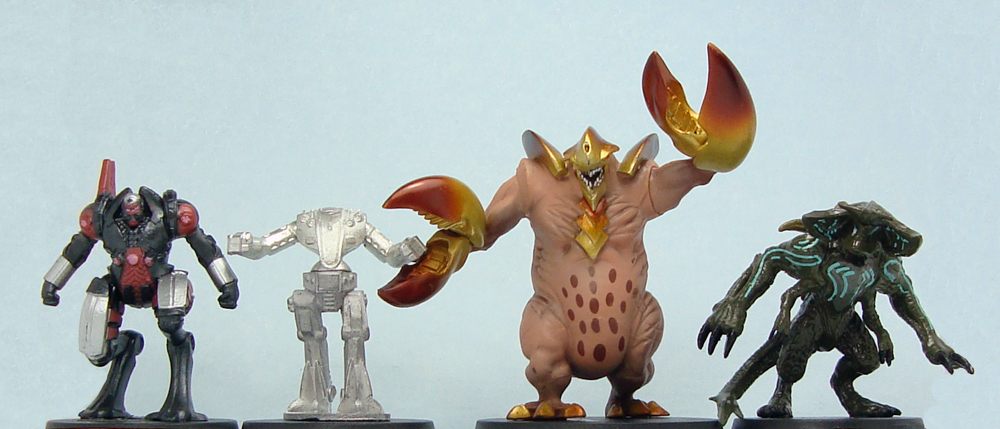
February 23, 2014Two more additions to my Pacific Rim project, which is pretty much complete when it comes to miniature acquisitions. Now all I need to do is start actual work on the project instead of just buying things. That’s not entirely true, actually, as I’ve got a fair few buildings put together already! More about those in a later post.
First up is Sasha Hammer. It’s a Heroclix mini, and the character portrayed is apparently an enemy of Iron Man’s. Just so you know. The mini itself is actually very nice, and fits the Pacific Rim aesthetic. With a slightly forward leaning pose, bulky upper body and reverse-jointed legs, the model gives off an air of menace. Sizewise it’s comparable to the other mechs I have, see end of post.
Joining the kaiju side is Zorog. Part of the Monsterpocalypse line, Zorog is an impressively large model. Most of the Monsterpocalypse (or “Monpoc” as it’s often called) minis are too cartoony to use in serious giant monster gaming, but Zorog fits in nicely – even with his massive pincers. Tall and bulky, Zorog received a larger 50mm base as opposed to the 40mm ones on (under?) the rest of the cast.
Both of these miniatures are actually quite nice as far as pre-paints go, and the vinyl is quite rigid. Of course they will be repainted, but if you were feeling lazy, they could be used as is. Both were fairly easy to pop off their bases.
Here’s a comparison pics to illustrate their size compared to my earlier purchases:
Now to actually get painting!

CAV mechs by Reaper – a review
February 6, 2014As part of my Pacific Rim project (see previous posts) I ordered some mechs from Reaper Miniatures‘ CAV line. They were such nice models that I figured I’d review them for the benefit of other hobbyists as well.
By way of disclaimer I have to say that I know nothing about the CAV: Strike Operations game, so I’ll be reviewing these purely from a “giant robots to be used in Pacific Rim style gaming” point of view. I’ll happily take the liberty of interpreting the designs as I view them, so vents might become guns and so on!
All the miniatures are sculpted by Chris Lewis, and have integral metal bases. I’ve glued them to 40mm plastic bases. There were no major casting issues, only minor mould lines and very little flash on some models. All except one of the models are four part castings consisting of torso, legs and two arms. The parts fit together nicely on all the models.
You can find all the miniatures in Reaper’s online store. Prices are from approximately 7.50 EUR to 8.30 EUR.
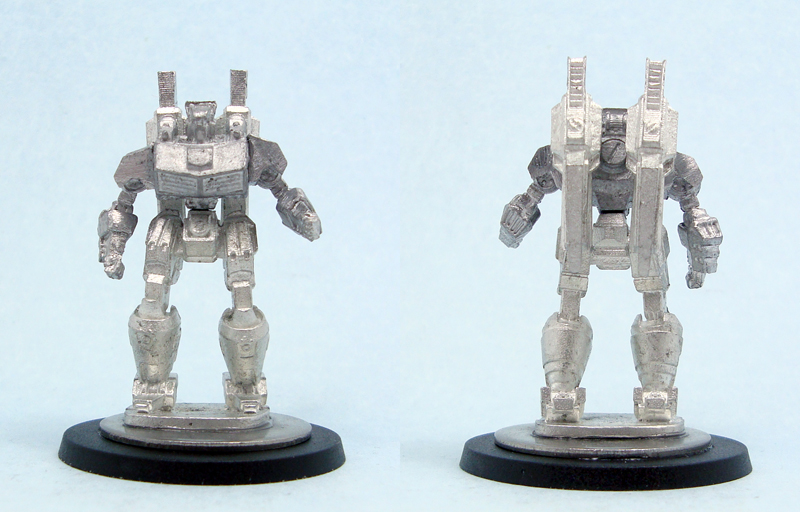
Hawk has a strong Transformers vibe, mostly due to the chest reminiscent of Optimus Prime. Hawk stands at around 49mm from the bottom of his soles to the tips of the things on his back. I’m not entirely sure what they are, although their design and the mech’s name suggest some sort of jet engines. They might be weapons, too. Anyone more familiar with the game, feel free to comment! Hawk’s smallis stature made me put it on a washer to give him a slight height boost. Of all the models in this review, Hawk might be my least favourite one – it’s just a bit boring. Hawk is the exception to the “models come in four parts” rule, as his back..things add an extra two parts.
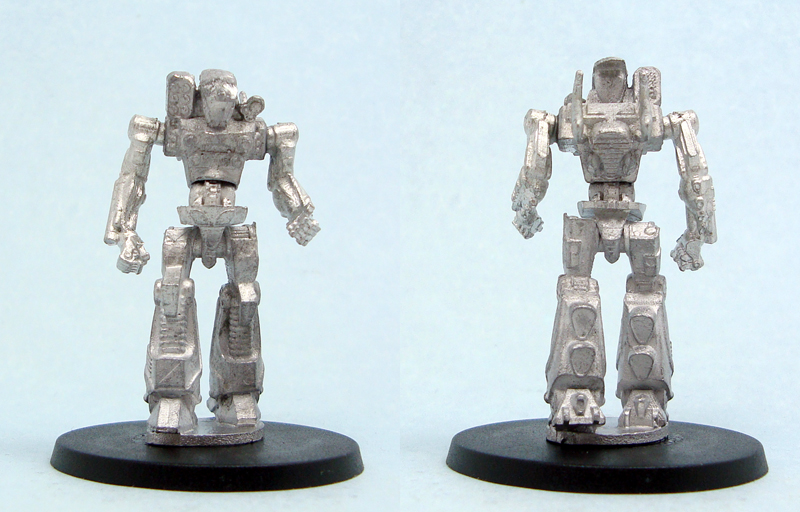
If Hawk was Transformers, Spitfire is Gundam. With sharp edges, reverse jointed legs and sloping armour, this one is the most high tech looking of the selection, and the first word that springs to mind is “sleek”. Spitfire isn’t too tall, standing at approximately 47mm from the bottom of his soles to the top of its head. This is a lovely, lovely design, and one of my favourites. Spitfire’s bracers have hollows that I envision as weapon barrels or housings for retractable weapons.
Weasel reminds me of an old boxer with its arched back, long arms and broad shoulders. The somewhat retro pose and design further reinforce this thought. Weasel is surprisingly characterful for a giant robot! While Weasel only stands at around 43mm or so. However, the squat design with the head a part of the torso makes the model look bigger than it is. There are four barrels on Weasel’s chest, and the pose suggests that they’re about to fire something. A bit like this piece from Pacific Rim:
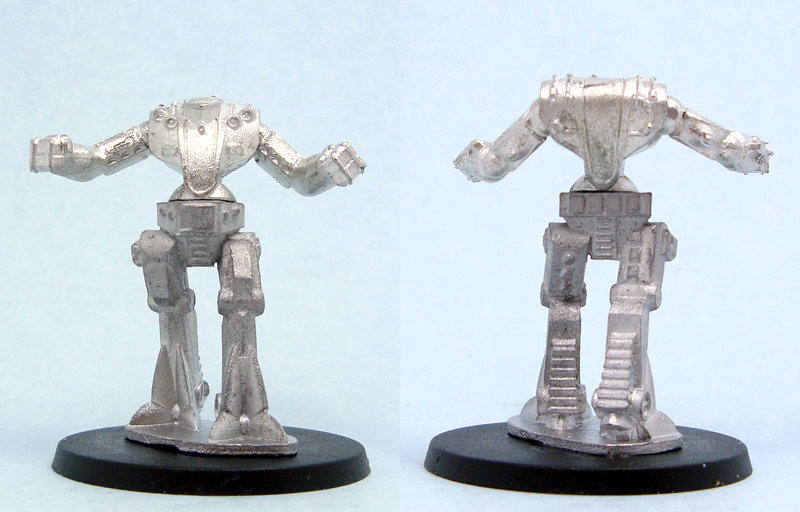
The first impression I got from Hemi was “lanky”. With a fairly short torso and long legs, it reminds me of an ent from the LotR movies. Of course this ent is metal and has a pod of six rockets on the right shoulder, which makes a slight difference. There are also four barrels/vents on its chest, a searchlight on the left shoulder and two fins on its back. There’s something very menacing and purposeful in the design. Hemi is roughly 46mm tall.
Dauntless might be my favourite of the lot. 50mm tall, clunky, bulky and swinging two massive fists, Dauntless is definitely the Cherno Alpha of this group. In addition to the very heavily built legs, Dauntless has two cannons on its shoulders. While the mech is only a few millimetres taller than the rest, it’s roughly 15mm wider than Hemi for example. You can really see the difference in the comparison pictures below. The size combined with the gorilla-like stance makes Dauntless look believably brutal.
Waraxe is the tallest of the models reviewed, at a whopping 56mm. As the name suggests, the mech carries a large axe. No, seriously. It’s a giant robot wielding a giant axe. How’s that for awesome! In addition to its namesake axe, the robot has a shoulder cannon as well as another gun in its left hand, reminiscent of a tonfa (aka nightstick). It has a slimmer build than Dauntless, and to my eye it looks a lot like a cylon from the new edition of Battlestar Galactica. The shoulder guards on Waraxe bug me a little bit, as they’re completely flat on the inside lending them an unfinished look.
Overall verdict: Well, these are some fine models. While writing the review I found it surprisingly difficult. Having never been into giant robots as a genre, I didn’t have many things to compare these to. I bought them for use in my Pacific Rim project, and for that they will be lovely as they’re a very characterful bunch. With good casting quality and nice sculpting, the main risk here would be boring designs for the robots, but that has been avoided here. Well ok, Hawk is a little boring, but he can be the exception to the rule. While I have a very specific use for the models, I can see them getting use in plenty of contexts and scales, so if you’re looking for some nice giant robots, you could do far worse than these.
The comparison pictures show the size of the mechs compared to each other. I also threw in some Pacific Rim Heroclix kaiju, as I figured there might be interest.