h1

Game design thoughts: First steps

April 5, 2026

As I mentioned in a previous post, I’ve been steadily putting some work into designing a miniatures game (with the working title Containment) for a while now – you can check out that post to find out why as well as general information about the game! While I’m currently unable to playtest, I have been making a bunch of tweaks to the rules and in general just thinking about what makes a game fun and enjoyable, what doesn’t (Sam Pearson’s game design channel on Youtube has been very inspirational, as has Patrick Todoroff’s blog), and what I want to achieve with this game.
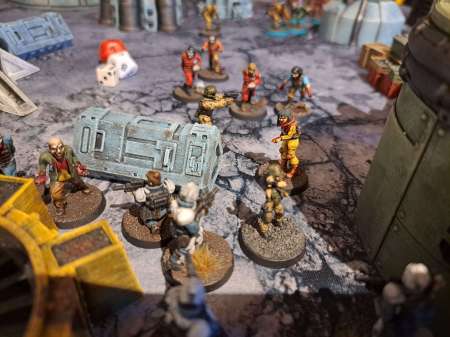
A close-up photo showing soldier miniatures surrounded by zombie miniatures in a science fiction setting

An oddly focused snap from one of my endless number of playtest games

As I felt like writing, I decided to share some of these thoughts. Who knows, this might even turn into a series of posts! In this post, I discuss the concept of the game, its influences, and how they have fed into my design choices in terms of mechanics as well as tone and setting.

Inspiration and first steps

The initial, bare bones version of the game was based on replicating a particular type of scene in “fast zombie” media: the one where there’s a military or police unit trying to contain a rapidly deteriorating, chaotic situation (hence the working title), with zombies – or whatever they’re called in the setting – sprinting in, impacting with the troopers, and bearing them down, only for the troopers to soon rise back up as zombies themselves.

A particular example is this scene in 28 weeks later which I can’t embed as it’s age restricted. It is also noteworthy for the callous approach of the military: at some point it just becomes “shoot everything that moves”. What elements make this scene, and how did they influence design choices when drafting up the basics of the game? Here are three elements relevant to me:

The situation is hectic

This isn’t measured grand strategy, but instead a panicked attempt to contain a situation that is already out of hand. The game needs to reflect this: there has to be a sense of pressure on the player. As I wanted to design a game for enjoyable solo play, I did not want to introduce something like a timer for the player; I want the game to represent a hectic situation, but not for the gaming itself to be hectic. I did, however, want to incorporate elements that convey a hectic feel while also serving the game mechanics-wise.

The central design choice here was that the core gameplay needed to be simple enough to be fast playing. No endless special rules, no calculating hit locations or hit points, no referring to the rules for each action. Also, I wanted there to be the possibility of situations changing rapidly, which led to the initial incorporation of quite a large random element, i.e. dice rolling. A third choice was miniature movement: the infected move faster than the soldiers, so if the soldiers want to do anything else than keep running, the infected will always catch up to them.

The situation is lethal

Tying in with the fast gameplay and genre conventions, death comes at you fast. In gameplay terms this for me meant no protracted hand to hand slogs, minimal tracking of model status, and merciless combat outcomes. In all honesty, the initial version was mainly a simple, brutal soldier annihilation simulator. This would also have design implications down the line, as discussed below.

A big part of this lethality is that soldier casualties quickly become enemies, potentially leading to horrible cascades: a soldier dies, resurrects, attacks the next soldier and so on. This is of course a big part of the zombie genre, especially things like 28 days/weeks later. I introduced two states for soldiers damaged in contact, bitten for “still able to function but will turn soon” and killed for “dead and becoming an enemy shortly”. The zombies, or infected as I soon started calling them, operate more simply. If they are attacked, they either die or they don’t.

The situation is awful

The third takeaway from the scene is more narrative: it’s a genuinely horrific situation with civilians fleeing in panic and getting killed and turned into monsters left and right, and the military electing to abandon all targeting restrictions and simply gunning down everyone, infected and civilian alike. It’s bleak and tragic, and I want some of that in the game. Conceptually, civilians and the potential for civilian casualties were a part of the game from the start.

However: did I want to make a game in which you can kill civilians, and is it overall advisable to include an element like that in a game? How to incorporate such an element without it being very unpleasant for the player, or should it always be unpleasant or repulsive for the player? Considering myself quite sensitive to toy soldier ethics, this prompted a lot of reflection. It also raised questions about the game’s narrative: who are the people who would do so and why? Would and should the game be super, super dark? This was a game I was designing for my own use, but would I actually want to play this game myself?

Putting it into practice

The first versions of the game weren’t great. Or rather, they very much did what I wanted them to do: the infected would run at the soldiers and civilians and the soldiers would get some of them but would eventually be swarmed, often as their companions turned into infected themselves. Combat was indeed very brutal and lethal, and it was hectic.

The problem with this was that it wasn’t very fun. Almost all playtests would turn out the same with some minor variations – every now and then a soldier might survive a bit longer, and rarely the soldiers might even win. It was a somewhat faithful recreation of the scene that inspired it, but…yeah. As anyone who has played Space Hulk knows, brutal combat can be exciting and tense, but it currently wasn’t. Even knowing that it was a very early prototype, things needed to change somehow. More on this in a future post, maybe?

Furthermore, it turned out that shooting civilians was, purely in terms of game mechanics, mostly a moot point: there was no time or reason to do so unless the table had far more civilians than infected, and a setup like that felt much too grim for my tastes, even if faithful to the source material. Now, in the current design stage of the game, a scenario like that is on the cards, but considerably toned down in terms of grimness and, more importantly, better in line with the game’s tone and setting. These two were the main outcomes of early playtesting and I’ll discuss them next.

Making terrible things fun: setting and tone

I knew from the start that in terms of aesthetics I wanted to set my game in a scifi future, largely because that’s my current miniatures kick. I wanted the blue collar kind of scifi in the vein of AlienOutland, and The Expanse, grounded in our reality, and kind of grubby and gritty instead of the colourful fantasy of Star Wars or the clean utopian visuals of Star Trek. However, combined with the subject matter, this pushed the game in a grim direction: awful things happening in a dirty future.

I’m not a very grim person, nor was I looking for solo play evenings filed with depressing narratives – our world has plenty of those without fiction. The solution? Add a bit of levity, make the horror a little more fun. This would lead to the tone and setting of the game.

As mentioned above, the soldiers controlled by the player would die quite easily and almost inevitably. Now, this usually isn’t very fun in a game: once you have your little troopers, you generally want them to stay alive. If you’ve played Jagged Alliance, XCOM, or Laser Squad, let alone Blood Bowl, it’s not fun when you lose your characters. My first solution was to alleviate this narratively by making the characters…bad.

I had wanted narrative elements from the start, so I decided to introduce personality characteristics for each soldier. These were mostly negative; I wanted characters whose passing wouldn’t really be mourned, so now the roster featured soldiers that were violent, lazy, cruel, vengeful, and 46 other things. This ten led to the game’s narrative core: what kind of organisation would these people seek and find employment in? A private military one, of course. Things just kind of flowed from there. “Violence for profit” was a good match for blue collar scifi with its corporate criticism – think Weyland-Yutani of Alien or the Tyrell Corporation of Blade Runner – and, as I wanted to make the game’s narrative a little less grim, it was a short step to gallows humour and satire from there. The soldiers were no longer soldiers, but operatives.

Dark themes and humour are by no means incompatible, just look at Judge DreddRobocop, Starship Troopers (apart from the original book), or even Warhammer 40k. The topic of futuristic private military companies seemed ripe for this kind of thing, allowed me to address some of my frustrations about late stage capitalism and the sanitisation of violence, and provided an important bit of humour and distancing from the dark subject to make it more enjoyable. I now had the setting and tone for my game, written out in my design document as:

a solo miniatures game of managing a futuristic private military company mounting high risk operations against masses of rage-filled infected to generate value for shareholders

Going forward

Now, these were initial steps in the design process taken more than a year ago, and the game has progressed a lot since then. It plays much better and has plenty more variation, there are the seeds of a campaign system, a lot more narrative elements and even the characters are not all horrible! The game is of course far from being finished, but I hope that the write-up above illustrates some of the thinking going into the game and how I’ve approached it.

Oh and what about the civilians? While it hasn’t been written yet, maybe there will be something like an evacuation mission with an acceptable level of ethical personnel reduction while prioritising key company asset security in target selection. Who knows, we’ll see.

If there’s an interest in more posts like this, do let me know, as well as if there are particular topics you’d like to know more about!

h1

From the painting desk #82 – Colonial…mercs?

April 3, 2026

Life carries on here in Norway (until the end of this month), and I’ve managed to get some more painting done. As the city is now very much quieting down for Easter holidays, today is a great day for a new blog post!

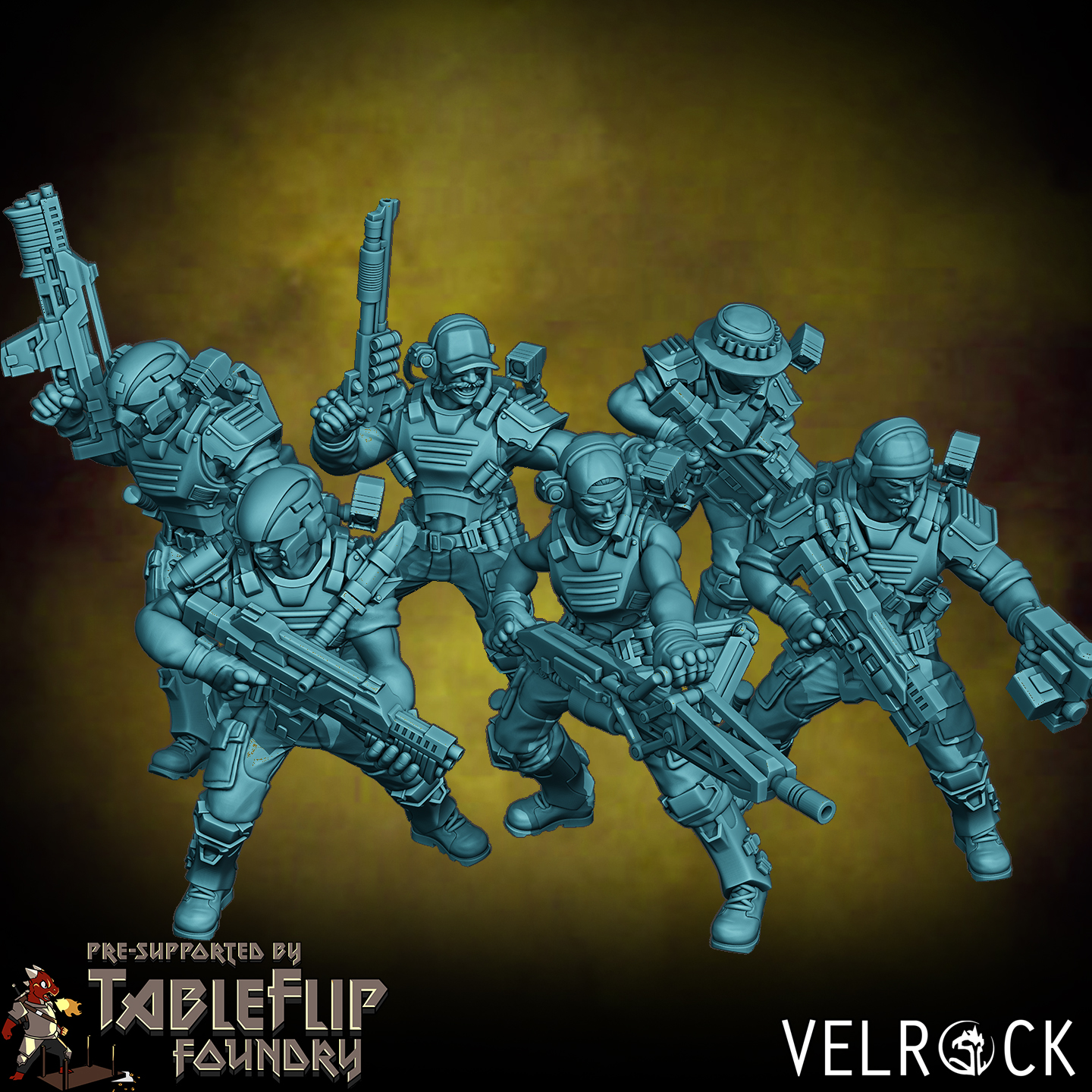
Work on Containment continues, and I’m still painting minis for use with the game. The game features different mercenary crews – sorry, private security contractors – which gives me a great opportunity to paint up more futuristic soldier types. I know I have a fair bunch already, but what can I say, I’m pretty much always up for more scifi military minis. Enter these printable colonial marines by Velrock Art Miniatures:

Renders of six colonial marine miniatures by Velrock Art Miniatures.
Picture © Velrock Art Miniatures

The minis have exactly what is needed for the game, with the different specialist roles represented (support, medic, sniper, comms/tech), one of them even touting a shotgun which is a weapon option in the game.

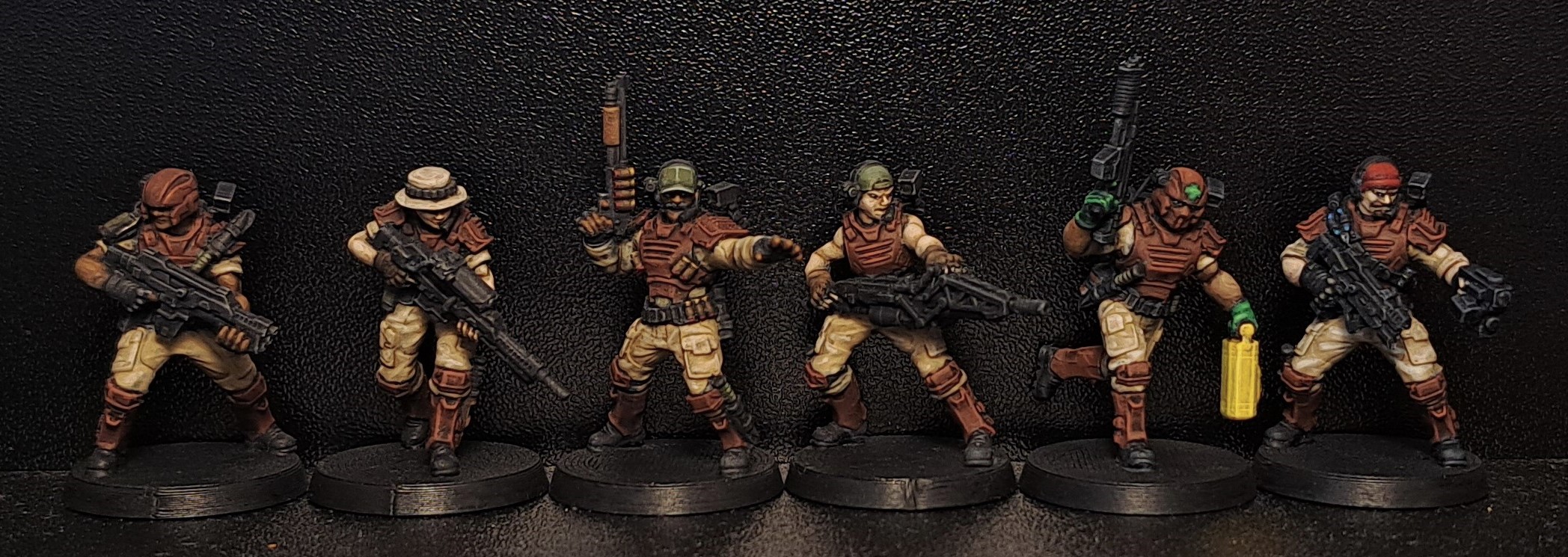
Years and years ago I painted up a ton of colonial marines as part of my various Aliens projects, and there’s even a painting tutorial I made sixteen years ago (and which has held up surprisingly well). However, because of that, I wanted to paint these up in a different colour scheme, something that was less “national military” and more “mercenary company”. Here’s what I settled on:

Six painted colonial marine miniatures by Velrock Art.
Click for a larger version

I feel like the rust red and khaki complement each other nicely and really help these minis look like they are not colonial marines, even despite the very recognisable weapons. I think I was inspired by an old 40k Imperial Guard colour scheme from way back! The lovely red was done using the great Rust and abandoned set from AK. I went with minimal small detail for easily readable minis. The sniper had their shoulder lamp snap off in transit (and impossible to glue back due to the tiny surface), but then again I figured it would not be needed anyway for that line of work. For the medic, I did add some bright splashes of colour for the gloves and the medkit and while they do stick out, I don’t think it’s too excessive. I also gave a touch of Jacques Cousteau for scanner guy’s hat.

Unusually for me, I’m showing off these minis with unfinished bases as I wanted to post about them but they won’t be based until a month from now when I get back home – while I did bring my paints and brushes, lugging over tubs of basing sand was where I drew the line!

h1

From the painting desk #81 – Average people

March 22, 2026

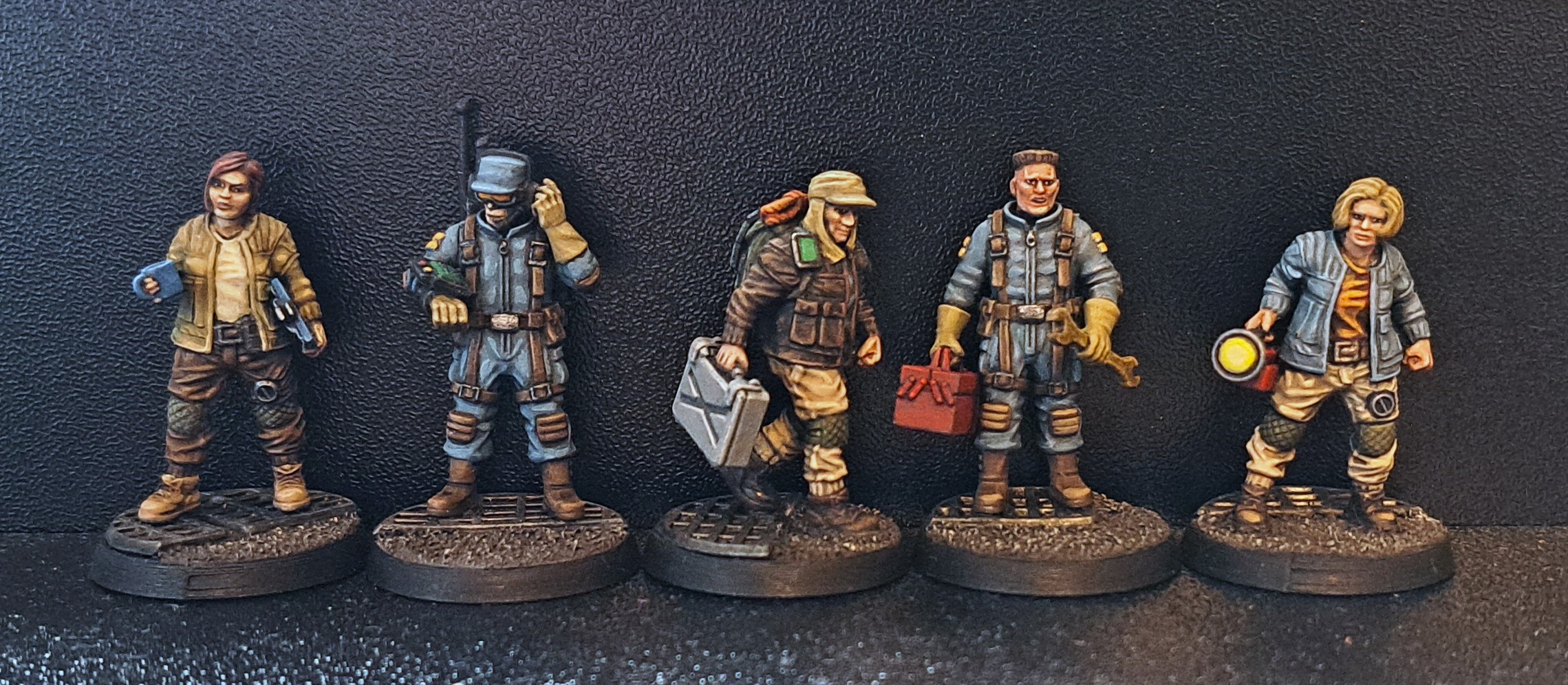
I am currently on a three month research visit to Bergen, Norway, at the University of Bergen’s Center for Digital Narrative, and decided to bring my paints with me. It has turned out to be a great idea, as I’ve actually gotten things painted! I’m continuing work on Containment, my ruleset for raging infected vs. mercenaries, and as part of the project I have been painting up scifi civilians – colonists for Alien-style blue collar scifi.

Five science fiction miniatures in a close up photo. The miniatures are from David Sheff Models and The Makers Cult.
L to R: David Sheff Models (DSM), The Makers Cult (TMC), David Sheff Models (DSM), TMC, DSM.

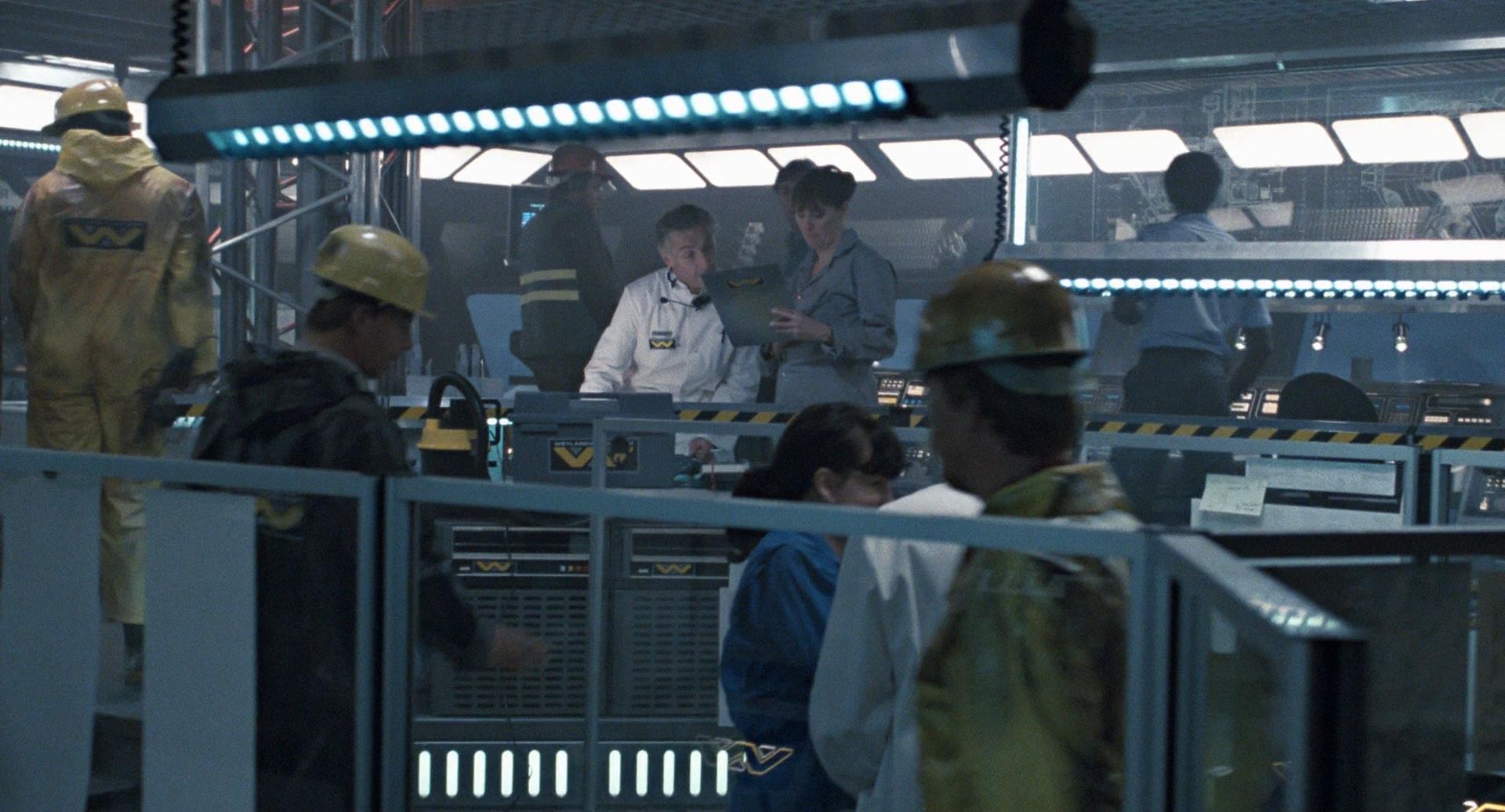
The models pictured here (and photographed in very non-ideal conditions) are 3d printed ones from David Sheff Models and The Makers Cult, with the mechanic having a head from Station Forge. I’ve really enjoyed painting these and I think they turned out nice! I went for quite muted, down to earth colours to suggest that these are very much everyday people, such as those shown in the deleted Aliens scenes depicting the Hadley’s Hope colony prior to xenomorph shenanigans.

Scene from Aliens depicting Hadley's Hope colonists.
Click for a larger version

In the game, civilians will serve a key role in some scenarios. They will need to be escorted and protected, whether as part of reclaiming colonies or panicked evacuation. They will also quite easily fall to infected attacks, obviously then turning into more infected, hopefully providing players with fun, tense moments and difficult choices.

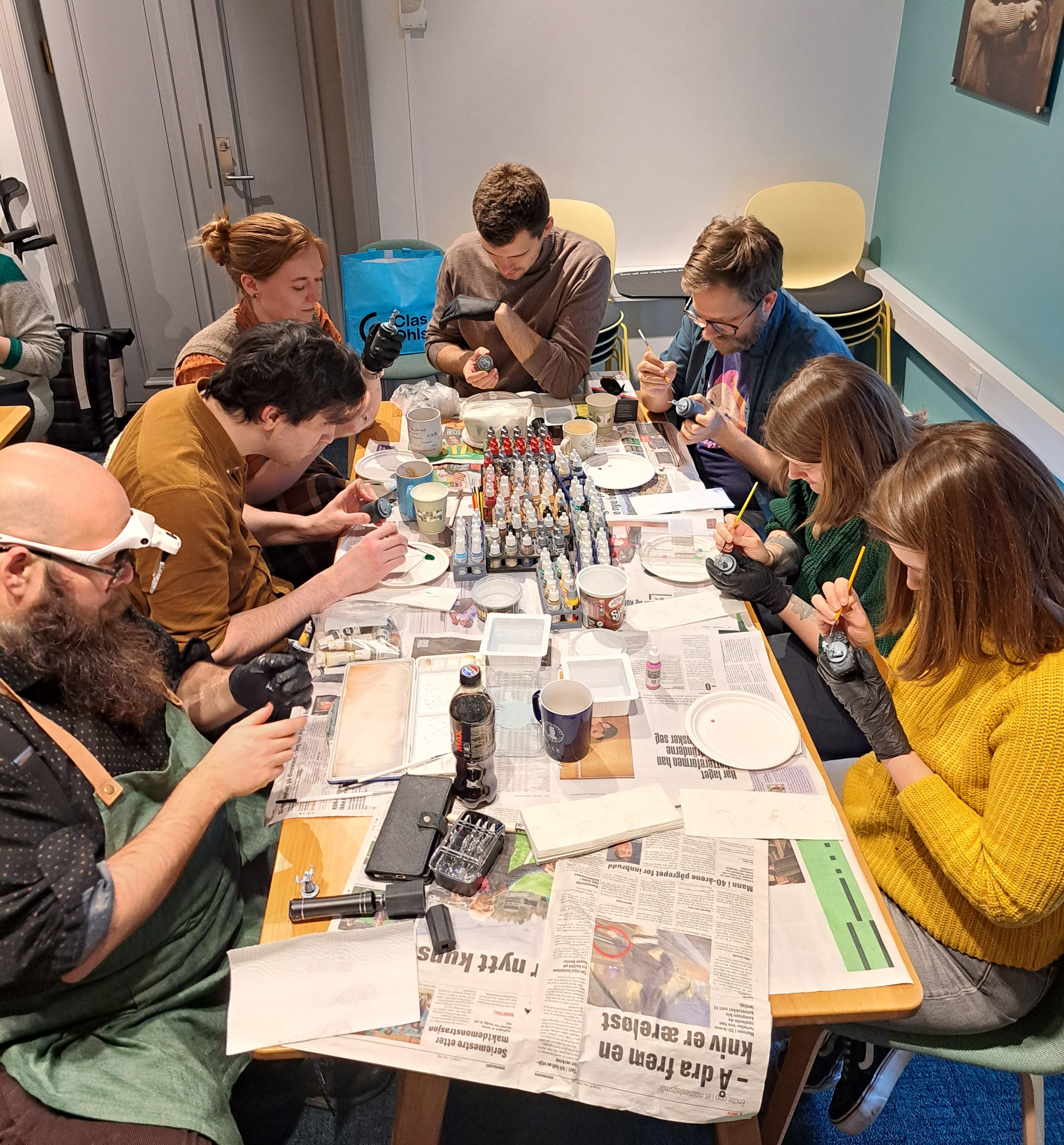
A lovely part of my visit here was organising a miniature painting workshop for my colleagues, most of who were complete newbies to painting! The reception was really enthusiastic, so I think there’s a volume 2 on the way…

A group of people of different genders gathered around a table painting miniatures.

Finally, as per usual around this time of the year, I’m getting geared up for Salute! Let me know if you’ll be there if you fancy catching up.

h1

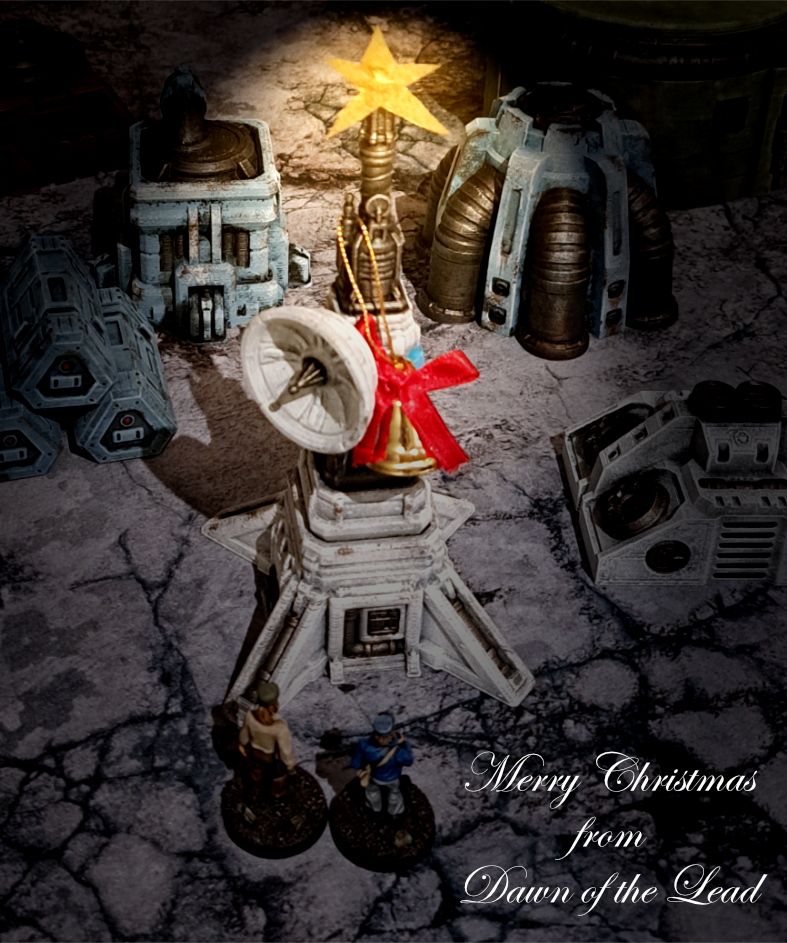
Merry Christmas!

December 24, 2025

h1

From the painting desk #80 – I came, I saw, I was inspired

July 28, 2025

For the first time in my life, I took part in a painting competition! I’ve been going to Ropecon, Finland’s main gaming convention (well, I say gaming, but it’s just a big overall geek fest) yearly since the mid-90s, and finally decided to put in an entry in the painting competition, Cold North Open. We threw the idea around with some friends – mostly non-painters – last year, thinking that it might be fun to participate just because. We did!

I was going to go all-in, but then my initial plans didn’t work and time ran out, and I was going to call it quits as a result. In the end, I decided to go for it anyway; life is short and there was nothing to lose. Enter three days/evenings/nights of merciless painting and a very sore neck, and I had this:

Click for a larger version

The model, which I entered in the Trench Crusade theme category, is a lovely, lovely model from Lost Heresy Miniatures. I’d seen the model a while ago, but since I’m not particularly into Trench Crusade, I’d kind of passed on it. Now that I was painting for a competition, I figured it would be a good opportunity to paint something for the fun of it.

In the end, I didn’t have success in the competition (should’ve probably gone a bit more grimdark for the setting), but apart from a moment of disappointment, it didn’t really bother me all that much. I’m happy with how the model turned out, and received some great feedback from the judges to improve further – essentially, all the skills are there but I need to think things a little differently for competition painting. I listened to a couple of great lectures – given by excellent Finnish miniatures painters – on competition painting and colour theory, and rather than intimidated, I felt really inspired!

While I’m not thinking of going all-in on competition painting or becoming a stellar painter, it also did feel really nice to push my skills a bit. Actively learning new things and pushing your skills can be really fun if done without pressure, and to be honest, I’ve been painting for such a long time that a sort of stagnation and routine has set in. It’s not a bad thing as such, and I’m really happy with how I paint, but I also really enjoyed focusing intensely on making a single model really nice. Also, as I don’t play a lot of miniature games, painting and storytelling are my main ways of engaging with the hobby, so improving my painting can and hopefully will increase my enjoyment as a whole, I think!

h1

Making a game

July 13, 2025

This year, I’ve gotten started on a miniatures game of my own and it’s been a fun project so far! This post is an introduction to what I’m doing, and might even develop into a series – although with my waxing and waning blogging enthusiasm, I’m making no promises. Anyway, it’s nice to get some ideas into writing and to an audience, no matter how small (quality over quantity etc). I’ll start with some key questions, maybe to prompt myself to some reflection as well.

What’s the game about?

Tying together a bunch of my interests, Containment (working title) is a solo game about private military contractors – mercenaries – clearing out space colonies after a disastrous rage zombie virus outbreak, inspired by films like Aliens and 28 Weeks Later, the comic Planet of the Living Dead, digital games like Jagged Alliance, XCOM, and Aliens: Dark Descent as well as (mechanics-wise) tabletop games like Five Parsecs from Home and FREAKZ!

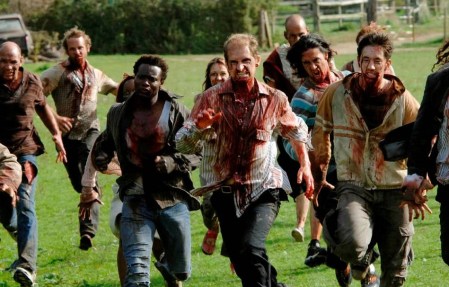
A group of running infected from 28 Days Later

It’s these guys vs. mercenaries, essentially.

The tone I’m looking for is kind of a darkly humorous anti-corporate satire: cleaning up the colonies has been outsourced to a bunch of more or less shady market operators that are in it mainly for lucrative government contracts and PR. The job is high-risk and pays well, and mostly attracts either the kind of person interested in killing for profit or those just desperate enough to sign up.

Close-up of Carter J. Burke from the movie Aliens.

“I work for the company. But don’t let that fool you. I’m really an okay guy.”

The game is designed with emergent narrative in mind. The characters have names, personalities, and some background – not a lot, but enough to maybe latch on to if you’re that sort of player – which influence things that happen both during and between missions. There are tables that hopefully bring up interesting and relevant things and nudge the player towards constructing some kind of coherent-ish narrative of the game events.

There might be a light company management element in there as well, but for now the emphasis is on developing solid and entertaining mechanics for the core gameplay.

Why make a game?

There are a couple of reasons and a fair few other things that have fed into this.

First of all, there isn’t a game out there that’s currently doing what I want, but there are many games that do a part of it. Five Parsecs from Home does a wonderful job of emergent narrative, and is a huge inspiration, but doesn’t quite capture what I’m trying to do here. The game’s Bug Hunt alternative/expansion, in turn, is similar to what I’m doing (smaller teams vs. horde), but I’ve found the narrative part too thin compared to the main game. In fact, this whole game creation process started from an attempt to expand on Bug Hunt. First and foremost, I wanted a game for me. I’ve written on the blog a couple of times (here and here) on the topic RPG elements in wargames, and a lot of that thinking is going into this game as well.

What do I want then? A fast playing, light solo game that is quick to pick up a play a few missions of, with light cognitive load: I hate memorising a million special rules and exceptions to those special rules, combined with a ton of variables based on, for example, different weapons and skills. This said, it’s a balancing act! The first version of Containment was essentially a game of luck with very few tactical elements. Boring, in other words.

Second, designing and developing a game is pretty fun in itself. I know several professional and semi-professional game designers, and we’ve often had a lot of interesting talks.  Having played games for a long time now, I definitely have my own particular likes and dislikes when it comes to game mechanics, and being a game scholar, I do spend quite a bit of time thinking why people enjoy playing games. Through both my work and 30+ years experience of RPGs, I’m not a stranger to the creative process either. So…why not try my hand at creating a game?

Third, as an adult, I’ve realised that it’s possibly to just…do things. There’s no magic to it, no-one you need to ask for permission, and so on. If you feel like creating a game, you can just create a game! Furthermore, it doesn’t have to be just a document in a cloud somewhere, but it can be an actual thing with a professional layout, illustrations, even dedicated miniatures. It might even be published, who knows! Sure, these things are not free, but in the grand scheme of things and compared with stuff like house renovation, they’re not crazy expensive either.

What’s going on at the moment?

The game’s rules are currently at a stage where I can play a pretty fun session or two. That said, there’s only a single mission at the moment, a traditional “you need to search these bodies for intel” thing or creeping in the midst of dormant infected who are waking up – slowly, unless you start shooting. New ideas for rules tend to pop up during gameplay, and they need to be tested, modified, and then accepted or discarded while trying to avoid a complexity creep. There are rules for dormant infected and when they wake up, evacuations (for ending missions), flashbangs (to momentarily distract and slow down the infected), and first aid injections (to give your poor bitten operative a few more rounds before they turn).

I’ll do some playtesting next week with a few regular gaming friends to see what they think of it, and I’m assuming there are more changes incoming after that. That’s really welcome though, as at some point you just become blind to your own work. I’m looking to release a version of the rules for playtesting “sometime in the future”, so drop a comment if you’re interested!

h1

What’s going on?

July 11, 2025

For the first time in a long while, I felt like posting on this blog! We’re in the summer holiday season here in Finland, so with work stress decreasing, free time increasing, and overall more (limited) sunshine and general fun, I find myself somewhat more energetic. Got to strike when the iron is hot and so on!

What’s up over here? Nothing much, which seems to be the usual middle-aged thing to say – work is good, eyesight getting worse (just bought my first reading glasses), hair thinning (which I’m not yet ready to accept), marriage still great. Being this old (well, not old-old but you get the point) feels odd in the context of this blog. I started this blog in 2009, at the age of 27, and I’m soon to be 43. Quite a lot has happened since then, both personally and globally!

Linking to the starter post of the blog from way back, I ended up reading it too! Seems like I’ve come full circle – or at least I’m at that point of a loop again. I’m currently working on my own gaming ruleset about zombies. What else could it be, right? Combining my key interests from past years, it’s a solo miniature game about zombies in a scifi setting with a seasoning of  corporate satire, as you manage a private military company – i.e. mercenaries – tasked with cleaning up infected colonies somewhere in the outer reaches of civilisation. The crew consists of more or less unsavoury types, with each character having their own (randomly generated) personality, which in turn affects their gameplay: a callous operative will have no qualms about putting down a bitten comrade, whereas a sensitive one might hesitate for a fatal moment, that kind of thing. The game is geared towards emergent narrative, the main inspiration being games like Jagged Alliance, XCOM, and Aliens: Dark Descent on the digital side, and Five Parsecs from Home and FREAKZ! on the miniatures side of things.

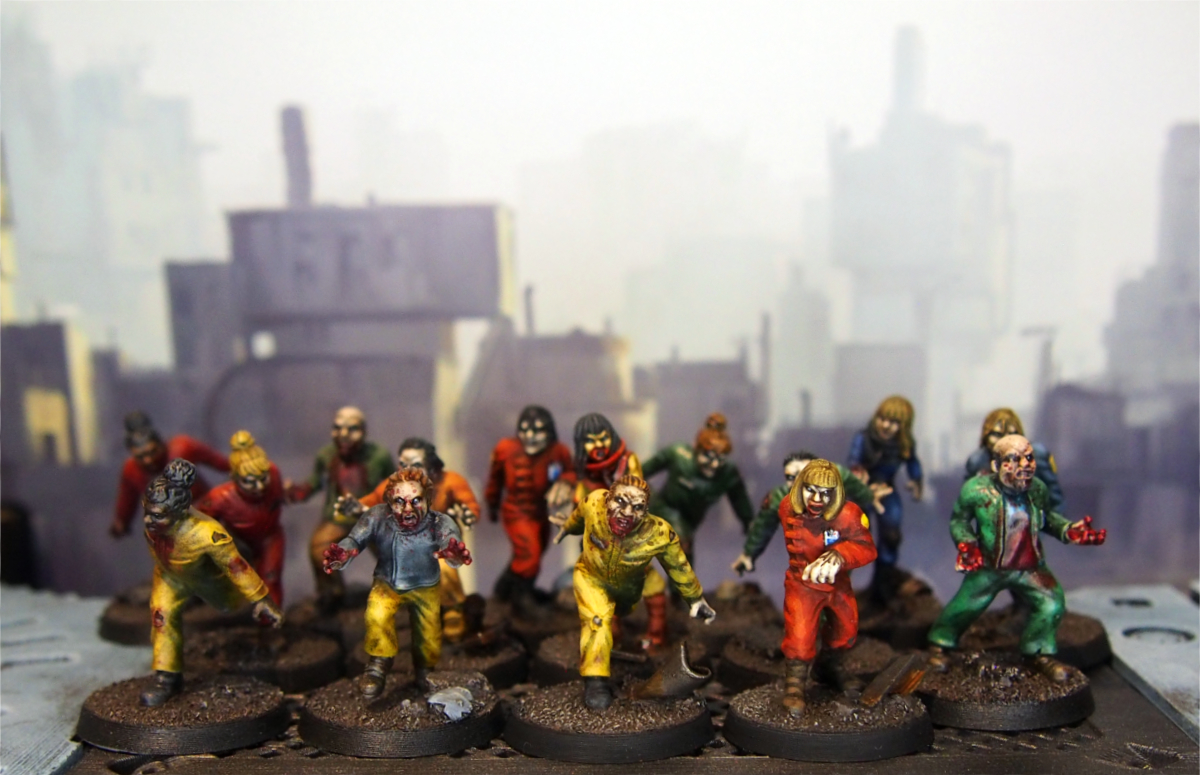
The design process and playtesting has given me a great reason to dig out a bunch of miniatures I painted years back, such as the zombies I was working on when this blog kicked off. In addition, I’ve obviously been printing and painting lots more zombies – fast ones this time. On the list are also some private military operatives as well as scifi civilians, all the usual suspects for a game like this. I’ve had a lot of fun doing some headswaps etc, both digitally and physically. For making a horde (well, 20+ minis) and working with a limited number of suitable models, the option to mirror models before printing is pretty useful. It doesn’t really add a ton of variety, but it’s something! So, here’s a bunch of painted models, they are mostly from Lost Heresy with a bunch of Knight Soul Studio heads thrown in. They’re overall lovely to paint, as they’re nice clean sculpts withouth excessive detail.

Click for a larger version

Click for a larger version

Click for a larger version

Glad to be back to blogging! No idea how regularly I’ll be posting, but it’s nice to resurrect this old thing every once in a while.

h1

Merry Christmas!

December 24, 2024

h1

Salute and the Pennine Way 2024

May 11, 2024

Life goes on, and occasionally the blog as well! For the first time in a long while I felt like typing something here, so here goes. Nothing dramatic as usual, busy with life things and all that. What follows is a description of my latest trip!

Salute 2024

I went, I helped BunnyBadger games put on participation games (and painted up a zombiefied Joe Biden and a glittery Taylor Swift for the Trumpocalypse game), I enjoyed the atmosphere, walked with Emmi around the show, met friends…the usual! My Salute purchases have been dwindling year after year, this year I got a bunch of brushes for both myself and Emmi for her craft hobbies. Ironically, some years after my long “only pirates for me thanks” miniaturing period has come to a close (for now at least), the theme of Salute was pirates. Oh well!

In addition to the brushes, I picked up some lovely, characterful futuristic law enforcers from Die Hard Miniatures. I put these together and cleaned them up last night, and I remembered how much work there is working with metal compared to resin casts and prints.

Photo of five painted futuristic law enforcement miniatures on a blue background.

Photo © Die Hard Miniatures

In addition to the miniatures, I bought the Sci-fi Backdrops picture book by Jon Hodgson, published by Handiwork Games. I was silly enough not to get in on the Kickstarter, but conveniently got this through Bad Squiddo. I had to quickly try it out, and I can safely say this is one of the must fun miniature-related things I have bought in years! As you probably know from reading this book, I game very little, but I do enjoy the storytelling aspect of miniaturing, so this is perfect stuff for me. I lined up a few scifi models for demonstration purposes.

Two miniatures posed against a science fiction background.

Click for a larger version

Two miniatures posed against a science fiction background.

Click for a larger version

The Pennine Way

If you’re a long-time reader of the blog, you might remember that five years ago Emmi and I did about a hundred miles of the Pennine Way national trail in the UK as our honeymoon. The trip was excellent and left us hungry for more, so we decided to do the whole thing of 268 miles. What followed was three weeks of beautiful views, bog (and more and more bog), quaint villages, friendly people, tiny lambs, and an amazing feeling of freedom in the walking bubble. While it was a physically strenuous trip, I guess getting to the blog after a long, long break is evidence that it was a welcome recharge of energy, creative included. I have about a million photos, but I’ll just share some choice ones below. If this feels tempting, I’m happy to provide advice!

It genuinely feels nice to be writing the blog after such a long break! Who knows, this might become a thing again. Anyway, I’m still alive and well and playing with my toy soldiers! How is everyone else doing?

h1

Merry Christmas!

December 24, 2023