h1

Hive pageant – Aliens game board update #2

February 13, 2012

After my last post I’ve received very good comments regarding the hive walls. I agree that the first test piece was lacking that biomechanic look so iconic to the Alien franchise, so I went to work on different prototypes. I bought some electrical wire (as it’s very cheap and holds its shape) and using blue foam offcuts and Tetra paste I knocked together three prototypes for hive wall styles. I’ve shown them painted, with everyone’s favourite smartgunner Drake for comparison. What do you think? They’re still lacking all sorts of lumps, holes, glue-goo, gloss varnish, ribbing and things like that, but these should give a rough idea. None of them are quite right, but I have a feeling I’m getting there. They are a bit sparse, for one, so I really need to add a lot more stuff in.

First test – While I like the spinelike ribbing on the vertical struts, I quickly noticed that the background desperately needs texture. It’s also a bit too spider web looking.

Click for a larger version

Second test – In this one I like the organic look of the tubes. It’s much too sparse, though. The addition of a simple texture to the wall makes a huge difference.

Click for a larger version

Third test – In my opinion this is the most Gigeresque of the test pieces. I like the ribbed texture on the wall. A lot of the wire was left exposed to create a smooth look. I used some heavy drybrushing to emulate Giger’s airbrushed style.

Click for a larger version

In my own opinion there are good elements in all of them that could/should be combined. I hope you’ll agree that these are much closer to H.R. Giger’s aesthetic than my previous outing. There are two styles of hive wall that I’ve spotted in the films. One is a very random, swirly, gooey one, whereas the other one is very much straight-off Giger with less “bio” and more “mechanical”.

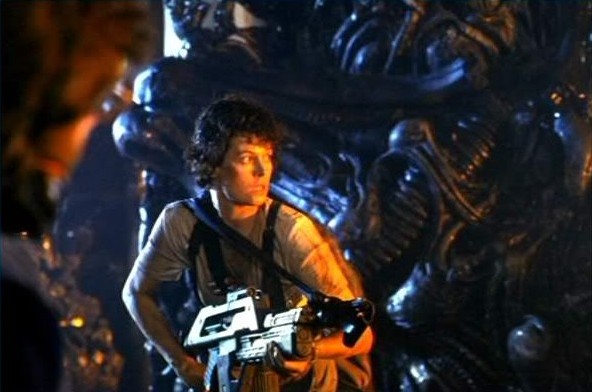
Here are some shots from Aliens to illustrate the look I’m trying to achieve. There’s obviously a lot of randomness, as well as plenty of organic looking strands of Xenomorph resin. Of course I’ll need to leave some original walls showing through as well to create a contrast between the man-made and the alien.

Click for a larger version

Click for a larger version

Click for a larger version

Now’s the time for comments. As you can see, I’m teetering between different options so input is very valuable at this time. Don’t be afraid to be critical, either!

h1

Dry heat – Aliens game board update #1

February 10, 2012

The Aliens board game game board (tee-hee) project I announced a while back is going strong. In this post I’ll take a look at what’s happening with it.

The board

In the previous post I wondered about a suitable flooring texture – brass and resin alternatives were too costly. I considered textured styrene sheets, but couldn’t find a suitable texture. In the end I settled for a cheap and easily handled material: plastic bug screen. It provided me with a nice mesh texture, and perhaps most importantly it was dirt cheap. I bought a large offcut sheet for 5€, and it’s over twice the size I needed.

Yesterday I cut a suitable shape from the sheet and glued it over the board with watered-down PVA. I left the staircase portion unglued. After the glue had dried, I carefully removed the rectangle with a craft knife. The bug screen has the added bonus of showing through the markings I made on the board earlier.

Click for a larger version

Today the mailman brought me the magnetic sheets that will be used to attach the terrain pieces to the board, so today will probably see some test fitting – not to mention testing whether the magnets have a strong enough hold. If they don’t, it’s back to the proverbial drawing board.

Accessories

The game board is clogged with various obstacles, and I’ve slowly gone to work on them as well. Shown below are some of the things I intend to use.

Various scifi bits and bobs from Ainsty. I bought these earlier to use in my Triton-4 Aliens/Predator/Colonial Marines campaign – which might or might not return. They’ll serve their purpose wonderfully here as well.

Click for a larger version

Scratch-built junk. Every miniature gamer hoards up things they might need one day. Lo and behold, this is “one day”! Out will come the random bits bought from hardware stores, beads, offcut pieces of sprue and miniatures and things like that. This project is a fine way to use them, since a lot will be covered more or less with Xenomorph gunk (more on that below). There is one innovation I’m actually proud of, and that’s using my Mantic bases. I’ve assembled quite a few from ghoul and zombie sets, and until now I’ve had no use for them. Now I’ve combined them with some of the extra bug screen I have, and they make wonderful exhaust vent -type thingies. A slight problem is that in the board game all obstacles block line of sight. In Aliens, however, there is steam billowing all around the reactor room (“Yeah, but it’s a dry heat!”), so I’m thinking of using craft wool to simulate steam issuing from the vents.

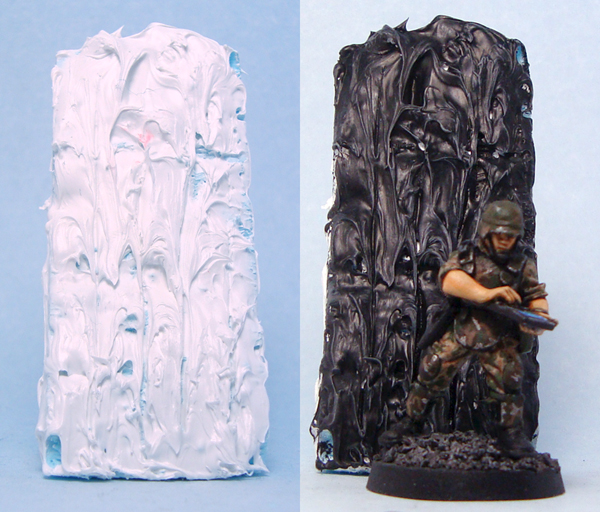
Alien gunk. This gave (and might still be giving) me a hard time. While I love the biomechanical Xenomorph look, it’s a bastard to recreate in larger quantities. Ready-made resin sets exist, but that would rapidly escalate the costs of this project – something I definitely don’t want. My current choice is to go with Tetra paste, which is a somewhat elastic paste for sealing windows, bathroom tiles and the like. This doesn’t produce a neat, organic surface, but rather a creepy, gooey one. It can be crudely shaped and takes paint well. Below is a quick mock-up using a blue foam offcut and some paste. On the right you can see the same piece with a quick, patchy paintjob (black with grey drybrushing, ink wash, I’ll later add some strands of glue for that sticky look) and a Marine to give you an idea of how it looks. Definitely let me know what you think. In my opinion it looks nice enough, even if it is a slight departure from the source material.

Click for a larger version

Miniatures

Unsurprisingly I have a whole lot of Colonial Marines. All I needed to do was pick out a suitable selection to match the characters in the film. I took some liberties to save me some time. What I needed was Apone (flamethrower), Crowe (pistol), Dietrich (flamethrower), Drake (smartgun), Frost (pistol), Hicks (shotgun), Hudson (pistol), Vasquez (smartgun) and Wierzbowski (flamethrower). Surprisingly I had less than half of suitable minis for these fellows painted. Like the Marines in the film, the lack of pulse rifles proved troublesome.

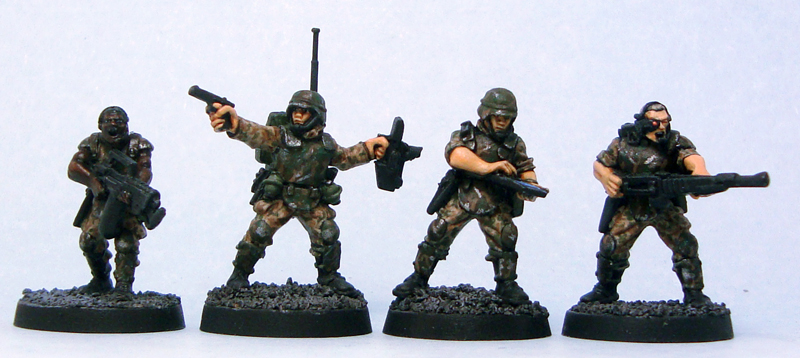
Here are the painted ones. Apone and Drake are from em4, while Crowe and Hudson are from Copplestone Castings.

L to R: Apone, Crowe, Hudson, Drake. Click for a larger version

And the unpainted ones. Apart from Frost they’re all Woodbine designs models. Frost is an as-of-yet unfinished conversion of an em4 plastic trooper.

L to R: Dietrich, Frost, Hicks, Vasquez, Wierzbowski. Click for a larger version

That’s the project so far. Comments and critique, send them my way!

h1

Author interview – Jonathan Maberry

February 6, 2012

Kicking off something entirely new for Dawn of the Lead, here’s my first interview. I’m starting big, as the first interviewee is none other than Jonathan Maberry, author of Zombie CSU, Patient Zero, Rot & Ruin and Dead of Night. Click the first three titles for their respective reviews, the one on Dead of Night is upcoming.
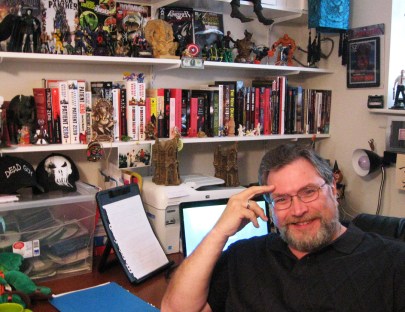
DotL: Why zombies? What is it about them that appeals to you?

JM: Zombies are one of the few monsters than can scare anyone. Vampires have been largely de-fanged by making them the romantic central characters;
werewolves are too often a one-note monster; mummies are slow. And most of these are solo monsters. Zombies come at you by the thousands. By the millions. Damn…you can’t really win against those kinds of numbers. And that is really frightening.

As a storyteller, I love the fact that the personality of the zombie doesn’t intrude into the story. They are metaphors –ravenous, shambling metaphors who stand in for anything we’re really and truly afraid of. Racism, nuclear war, pathogens, you name it. So, once they’re introduced into the story all of the characters are reacting to the same shared threat. That allows the writer to focus on real people and real human psychology. That is an infinite canvas on which to paint dramatic images. I mean, look at the more celebrated zombie novels: Max Brooks’ World War Z, Joe McKinney’s Dead City and its sequels, Brian Keene’s The Rising, S.G. Browne’s Breathers: A Zombie’s Lament, Carrie Ryan’s The Forest of Hands and Teeth, Ryan Brown’s Play Dead, and Cherie Priest’s Boneshaker. They’re all zombie novels and they aren’t even remotely close to one another. And they’re all about the human experience during a crisis. All of them.

Here’s a secret: the best way to tell a zombie story is to NOT focus on the zombie. Focus on the people and let the zombies be the Big Bad. Those are the best stories, and they are far more frightening than when all of the attention is on the shambling dead.

DotL: Are you a fan of other media promoting apocalyptic scenarios? If so, any examples and some elaboration?

JM: Apocalyptic scenarios are very much the in thing right now, and I’m all for it. I love the fact that the CDC (Centers for Disease Control) sent a mass
mailing on what to do during a zombie outbreak. Inspired…because the information is truly useful if there is an outbreak of any major disease, but because it was zombie-themed, more people read it. So many, in fact, that it crashed the CDC servers!

But zombies are showing up everywhere, and that’s wonderful. I love zombie comics – Marvel Zombies is a favorite, of course, because I had the chance to collaborate on the New York Times bestselling Marvel Zombies Return, with Seth Grahame-Smith (Pride and Prejudice and Zombies), David Wellington (Monster Island, etc.) and Fred Van Lente (Cowboys and Aliens). And, Robert Kirkman owns zombie comics, probably now and forever, with his brilliant The Walking Dead. I’ve been a fan of that comic from the jump, and I love the TV series.

There are zombies everywhere – advertising, toys, video games, food, you name it. And I love every damn bit of it. Zombies, zombies and more zombies. Keep ‘em coming.

DotL: Every zombie buff out there has seen their Romeros, Fulcis and read their Max Brooks and Kirkman. Any interesting, lesser-known genre picks and personal favourites you wish to share with the readers?

JM: As much as I love Romero, my favorite zombie movie of all time is the Zack Snyder remake of Dawn of the Dead. Specifically the unrated director’s cut. James Gunn’s script was brilliant, the cast was perfect, the soundtrack kicked TOTAL ass, and the action is great. I love fast zombies on film as much as slow ones.

But my favorite flicks are in the sub-genre of ‘rage virus’ films. 28 Days Later, and both versions of The Crazies. I want to see more of those. In fact I plan to write a rage virus novel.

I also love the RomZomComs. Shaun of the Dead, Zombieland, Fido and Braindead. Love ‘em to pieces.

DotL: Back in Zombie CSU you presented an informed guess that law enforcement and humanity in general would be pretty efficient in containing a zombie outbreak. However, in Dead of Night things go to Hell in a handbasket pretty quickly. Is this purely a dramatic choice of worst-case event, or are you having second thoughts regarding the scenario?

JM: Zombie CSU dealt with the zombie apocalypse as viewed through the filter of our modern-day high-tech infrastructure. I do think that, given the technology and resources we have available that we would, in fact, survive a zombie outbreak. However, there is no such thing as a guaranteed win. Ask the builders of the Titanic. So, in Dead of Night, I throw a major storm into the mix. We know from experience that society, communications, cooperation, efficiency and infrastructure can quickly go to hell in a handbasket if Mother Nature gets cranky. So…it’s a timing thing. Lately, we’ve seen an increase in the frequency and severity of storms, tsunamis, earthquakes and other natural disasters. If we’re unlucky enough to have a major catastrophe such as a pandemic timed to a natural disaster….well, yeah, that’s your apocalyptic moment right there.

DotL: The main characters in both Patient Zero and Dead of Night (and Rot & Ruin to some extent as well) have anger and aggression issues. Do you have a general penchant for angry characters, or are these fictional people a way to let off steam? Do you see yourself writing a zombie novel with a happy-go-lucky protagonist?

JM: I was a troubled kid, so I grew up with some rage issues of my own. I’ve since conquered them (and in fact I’m kind of an affable goof these days), but I remember what it’s like to have emotional damage and to struggle with anger. My own life experiences, and those of many of the folks I know who have had similarly troubled lives, inform the complex characters I prefer to write about. Fiction in general is seldom interesting when the focus is on well-balanced people having a pleasant day. In fiction we take complex characters and totally screw up their lives…and then watch what happens. That’s the core of drama.

That said, I did write one zombie short story that was a straight comedy: “Pegleg and Paddy Save the World

DotL: Zombie CSU and Dead of Night both demonstrate (to me at least) a good knowledge of law enforcement procedure. Where did you pick up all this information?

JM: I grew up in a blue-collar Philadelphia neighborhood where it seemed like everybody’s dad or uncle was a cop, and my sister was a cop. Also, I was the CEO and chief instructor for a small corporation that provided hand-to-hand combat and arrest-and-control workshops to all levels of law enforcement including SWAT. Plus I have a large number of friends in that line of work.

DotL: Can we expect a sequel to Dead of Night? If not, do you have plans for more zombie fiction in the future?

JM: I have no immediate plans for a sequel to Dead of Night, at least not a novel. However I do have some other stories set in that world. First up is a novella called “Jack and Jill”, which will be including in the upcoming anthology, 21st Century Dead, edited by Christopher Golden (for St. Martin’s Griffin, June 2012). That story takes place at the same time as the events of Dead of Night but with a different cast of characters. I also have the first of several sequel stories – outbreak stories, really — that will appear in various magazines and anthologies. The first of those is “Chokepoint”, which will be in issue #2 of The Uninvited. And more to come. Now…that doesn’t mean I
wouldn’t take a swing at a sequel, but at the moment I haven’t pitched one to my publisher.

DotL: If we in all seriousness hypothetically consider a zombie outbreak happening, how do you rate your chance of survival and why?

JM: I’ve been practicing and teaching jujutsu and Kenjutsu (the art of Japanese swordplay) for almost fifty years. If the zombie apocalypse comes…I will fight my way out. Stick close.

DotL: Jonathan Maberry, thanks for your time and all the best for the future!

See reviews of Maberry’s books here on Dawn of the Lead, and visit his homepage at www.jonathanmaberry.com.

h1

Blood Bowl-a-rama #10 – an unkindness of Ravens

February 1, 2012

Did you know, that a flock of ravens is actually called an “unkindness”? Really! Read a column on the subject here.

Anyway, this curious piece of linguistics brings me to the main point of this post – namely my completed Blood Bowl team. There are a few extra models, and I have one werewolf pending a repaint. Other than that, here are the Drakwald Ravens in their gothic glory.

Click for a larger version

As you may have noticed, there are some players in the photo that haven’t been introduced yet. They are:

Arthur Schopenhowler the werewolf. I simply love this model from West Wind, see the review here.

Click for a larger version

A man can be himself only so long as he is alone. 

– Schopenhowler

Jürgen Habermassacre the flesh golem. The model’s a tank zombie from the FU-UK sculpting competition a few years back.

Click for a larger version

 One never really knows who one’s enemy is. 

– Habermassacre

Georg Henrik von Wight the..wight. The model is a custom build from GW plastic parts.

Click for a larger version

If one is satisfied with things, one doesn’t complain about the downsides that exist, either. 

– Von Wight

There you go! An actual, completed project. Should I need another werewolf, I’ll simply give the pants and base of a previously painted West Wind critter a quick repaint.

h1

Rot & Ruin – a review

January 28, 2012

(This review contains no spoilers)

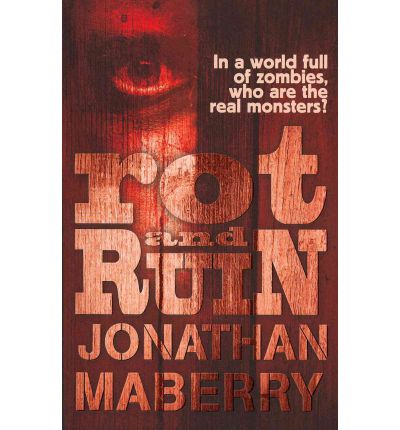
Closing in on thirty, I’m going ever further from the Young Adult demographic. That didn’t keep me from picking up Rot & Ruin by Jonathan Maberry. A zombie novel’s a zombie novel, and I quite like Mr. Maberry’s work.

Rot & Ruin starts the story of Benny Imura, a boy of fifteen, living in a post-apocalyptic world. Fourteen years ago zombies happened, and since then the world has degenerated into a Wild West of sorts. Kind of Mad Max meets Fallout meets The Walking Dead. Technology is severely lacking, and Benny lives with his brother Tom in a small settlement. It isn’t long before things get funky, and what starts out as a teenager’s quest to find a job quickly turns into a fast-paced adventure.

I don’t read much Young Adult stuff, but I guess I should if it’s the same quality as R&R. Having read Maberry’s Patient Zero and Dead of Night (review forthcoming soonish), I didn’t quite know what to expect. His main characters tend to be hard boiled kick-ass types, and I wondered how he would portray a 15-year old. I was happy with how the character of Benny was handled. Yes, he tends to be annoying, petulant, irrational and just plain dumb, but then again who wasn’t at fifteen? In my opinion he’s Maberry’s most human character to date. The supporting cast is none too shabby either, and I ended up caring about their well-being. The good guys are good, the bad guys are bad. Neither are from cardboard, however, and there are justifications to their actions.

Where Rot & Ruin excels, however, is in its treatment of the zombie apocalypse. Surprisingly it’s a much more mature book than either of Maberry’s previous works of zombie fiction. Whereas in those books the zombies were basically just a very clear and present, acute threat, in Rot & Ruin the apocalypse and zombies are viewed in a wider scope. Key questions of the genre are asked: are zombies monsters or victims? Are they morally responsible for their actions? Why is it difficult to kill zombies? I think that asking questions and seeking answers are a staple of YA books, and such an approach is very suitable in the zombie genre as well. Just like Romero’s original Dawn of the Dead, the zombies in R&R are shown as not only monsters, but also creatures heartbreakingly empty and lost. As is often the case in zombie stories, the worst monsters are usually the living and breathing ones. Rot & Ruin manages to be a genuinely touching book, an all too rare occurrence in a world where the only qualification required to be a published zombie novelist seems to be the ability to write “braaaaaaains“. The fact that Maberry manages to include a lot of suspense and gory action into the mix is proof of his skills as a writer. Another testament is that the book carries its length of 460+ pages easily.

Some minor issues irked me, but these are things often encountered in books about unexpected heroes (Lord of the Rings and the Harry Potter books spring to mind). In R&R some characters suddenly act just a bit more callously or bravely than you would expect them to. As mentioned, this is in my view a part of the genre but nonetheless somewhat disrupts the coherency of the characters momentarily. There is a bit of a deus ex machina ending, but I’m more tolerant of it here as well. I would also have liked a bit more of a surprise in the climax of the book. It was all in all a good scene, but not as effective as it could have been.

Overall verdict: It’s hard for me to describe what exactly it is about Rot & Ruin that makes it so appealing. Maybe it’s the grassroots approach, maybe it’s the YA vibe that comes from easy readability and themes such as growing up. Maybe it’s the thoughtful take on zombies. Whatever it is, it works very nicely. Paradoxically, writing to young adults, Jonathan Maberry has written his most mature piece of zombie fiction. There is a sequel to the book, called Dust & Decay and it’s already on my shopping list.

As usual, I picked up my copy from the Book Depository.

On a related note, Jonathan Maberry will be interviewed on Dawn of the Lead at the start of February. Stay tuned!

h1

Flu – a review

January 21, 2012

I’m currently vacationing in sunny Sri Lanka. To while away my time in the sun, I took a fair few zombie books with me. This serves the triple purpose of providing me with both entertainment and something to review and offering you something useful to read. First up is Flu by Wayne Simmons.
The concept behind Flu is very simple. It’s another flu (just like with the avians and the swine) that hits, first provoking the usual panic, jokes and cynical dismissal that these things tend to do. Only it starts to get a lot worse. There are quarantines, deaths and eventually re-animations. You know how it goes from there.

The book’s setting is an interesting one, as it’s set in Belfast, Northern Ireland. The place has a rough history of political division and internal strife making it an interesting backdrop for a story with or without zombies. Wayne Simmons has managed to incorporate strong elements from the setting into the story, and Flu doesn’t feel like yet another foray into the generic US city that frames most zombie novels. There are bitter enmities and deep regrets as well as historical references and the like. The writer manages to write these into the story without being too heavy-handed. When criticism is levelled, it feels done by the characters and not the author. Personally I hate having a political ideology, religion or anything similar crammed down my throat when I’m trying to enjoy some zombie action, so I was happy with the way Simmons handled his subject matter. They serve the story’s purpose and not the other way around. Simmons hails from Northern Ireland, and it’s apparent he knows what he’s writing about.

Another thing I applaud is Simmons’ writing style. He doesn’t waste his pages and there isn’t a lot of empty filler in the book. In roughly 280 pages he manages to tell a good story, introduce the reader to a handful of characters and include the above mentioned themes into the mix. He drops nice hints here and there about how things went down when the flu struck, and there are some excellent little details there that make it hit a little closer to home.

The characters are a nice collection, too. None of them feel like cardboard cut-outs. The story follows each character’s perspective at some turn, and you get a glimpse or their motivations and inner workings. Nobody’s perfect, nobody’s a complete mess-up. They feel pretty much human, with their good and bad traits. At times it feels like Flu might make a nice movie, probably a Guy Ritchie one. The reason for this is the combination of a tragic situation, some dark humour and imperfect characters. It works wonderfully for me.

There wasn’t much in the book that irked me. A pet peeve of mine raised its head a few times. What is it with zombie book authors and firearms? Seriously. Once I know it’s a Glock 17, it can be referred to as a pistol. Do I even need to know it’s a Glock 17? This isn’t to say that the book is brimming with gun information, thankfully. There’s just a bit too much needless repetition at times. Also, the military strand of the story could’ve been developed a bit more as it felt a bit detached. Apparently this is taken further in the upcoming sequel Fever, which is a welcome piece of news.

Overall verdict: Flu doesn’t really bring that much new to the genre. A lot of the usual tropes are there – the tension between survivors, hidden agendas and friction between the establishment and civilians. Normally I’d view this as a failing on the book’s part. A book with nothing much in the new idea department needs to be pretty good otherwise to float, and luckily writer Simmons pulls it off. Flu is an intense, compact book, and well worth your reading. I ate it up in two days, and am still hungry for more.

I picked up my copy of Flu at the Book Depository.

You can check out Simmons’ homepage here.

h1

This time it’s war – in 3D

January 13, 2012

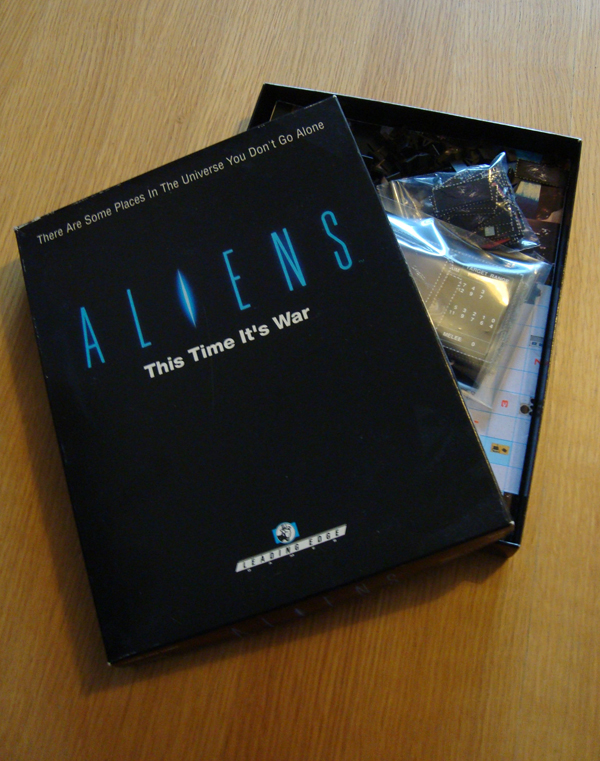
With my Blood Bowl team pretty much done (pictures coming up soonish), and armed with experience gained from building my BB pitch, I’ve decided to start a new project. I went through my boxes of old stuff some time ago, and dug out the old Leading Edge Aliens board game that I bought for a pittance years and years ago. I’ve played this game so many times in my teens, due to its solo play option.  I remember sitting in my room at the age of 14 or 15, and just playing the game over and over and over again.

Aliens board game

Click for a larger version

It wasn’t too difficult to form the following chain of thought: “Hmm, I really want to play this game again” to “I have loads of Colonial Marine and Alien miniatures” to “I wonder if the playing board accommodates 28mm miniatures – no” to…oh, you know how it goes. So now I’m looking to build a 3D gaming board to recreate the main – and in my opinion best – scenario from the game. It’s of course the reactor room one, where most of the CM squad is ripped apart. It’s a pretty difficult and brutal mission, but perfectly captures the feeling of the movie. Don’t believe me? Try the Flash version and come back!

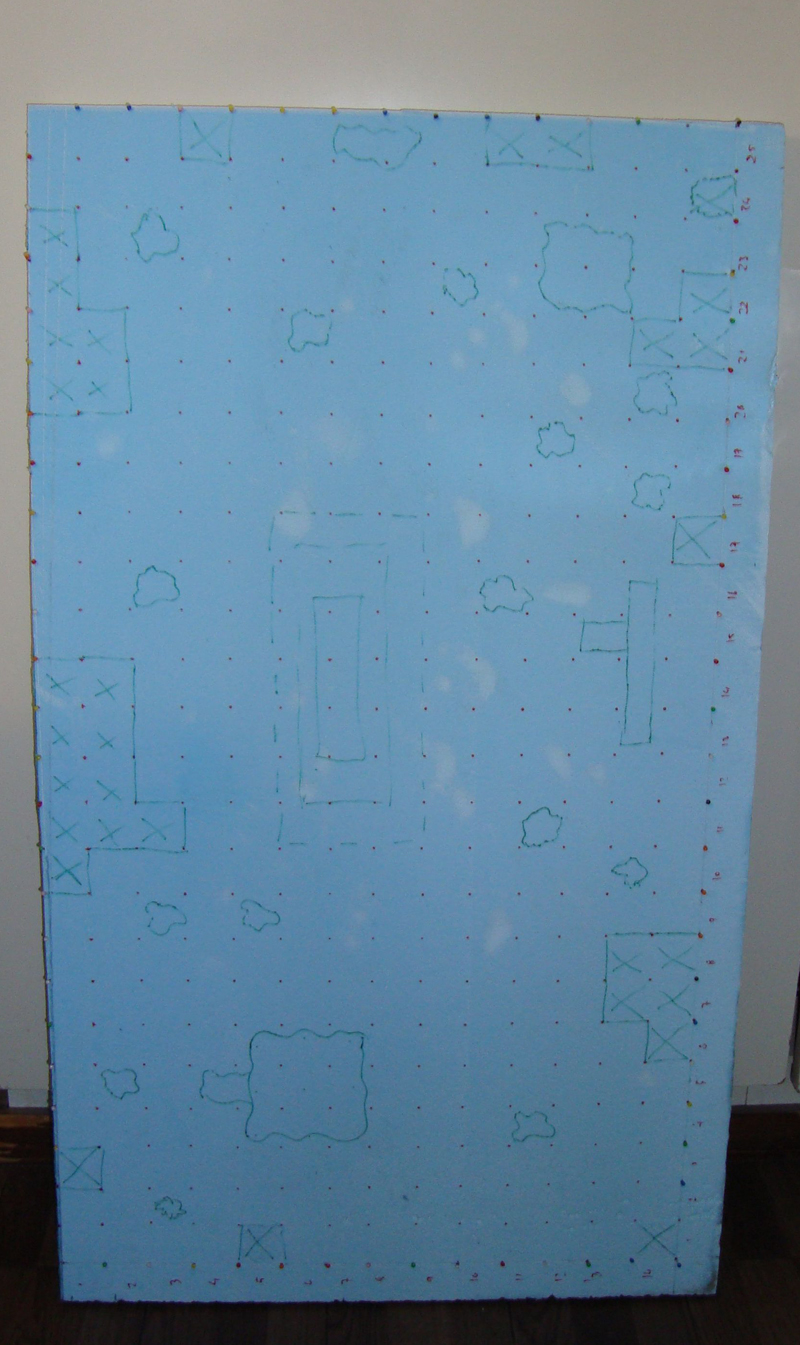
With this in mind I picked up a sheet of blue foam and the Aliens game board and did some calculations. The original board is 14 by 25 squares. When I translated the squares to 30mm ones and left some extra room at the sides, it amounted to a 42,3 cm by 75,3 cm board. Perfectly reasonable size, only a bit larger than my Blood Bowl pitch. Storage is always an issue for me when it comes to wargaming scenery. Or rather, it has started to become an issue due to not being an issue before.

The Blood Bowl pitch project certainly taught me something, and that was to be careful with measurements and cutting. As a result, the Aliens board is much more symmetrical and the square grid much more even. I used the same push-pins and string -technique to build the grid, and used a felt-tip marker to mark the corners of the squares. Much more fun an easy than with the pitch.

After doing the grid, I marked down or the obstacles on the board so I know what to build and where, and that’s where I’m now. I’m thinking of attaching the various bits and pieces of the game board – at least the larger ones – with magnets, so they can be removed for easier storage.

Click for a larger version

(No, it’s not that irregular – the camera angle’s doing some nasty tricks there!)

What’s next? I’m thinking of buying a suitable plastic or metal mesh to use as flooring. While there are some nice stuff in resin and etched brass out there, I’m trying to optimise the cost/looks ratio. For the obstacles it’s going to be lots of scratch building, green stuff and some resin accessories I have stashed away. That’s one great thing about starting projects, especially thematically similar ones: you can use leftovers or stuff bought for something else easily. And of course I have all the Marines and Aliens I need already.

Ideas, comments, insight and encouragement warmly welcomed.

h1

The best zombie movie scene there is

January 12, 2012

There are some mighty fine zombie movies out there. There are lots of great scenes in them, too. Funny scenes, scary scenes, touching scenes. However, there is one scene for me, that will always stand head and shoulders above the rest: the Day of the Dead opening one.

It’s a very, very simple scene: a helicopter with four survivors lands in a deserted city, looking for survivors. Two of them run outside while a third one operates the helicopter radio, calling for any possible survivors. Outside, a military man calls desperately into a bullhorn: “Hello! Hello! Is anyone there? Hello!” You can see from his face and hear from his voice that he’s near a breaking point.

We are shown shots of a deserted city. There’s an alligator at a bank’s doorway. Palm leaves, abandoned cars and newspapers (with the classic “The Dead Walk!” headline) litter the street. A wind whips dollar bills around.

Slowly the survivors’ calls are answered, as zombies start to shuffle from inside and between the buildings. A few at first, then more and more. The survivors flee to their helicopter as the street fills with the walking dead.

And that’s it. Simple, elegant, effective and amazingly bleak. This five minute clip manages to convey the horror of a zombie apocalypse better than many full movies on the subject. It’s not the zombies that are the horrific thing. Sure, they are bloodthirsty monsters, but that’s not it. The horror stems from the emptiness.

“Hello! Hello! Is anyone there? Hello!”

There isn’t. It’s a bright sunny day, it’s a decent sized city, they’re calling into a bullhorn in the middle of the main street, and yet there is no-one answering. The abandoned paper money lets the viewer know there hasn’t been anyone for some time. Never mind the buildings or the cars, the loose money is the best indicator. The palm leaves and the alligator suggest that nature is slowly taking the city over and it’s falling into ruin – an entire city. Its new occupants don’t care anymore. The sheer desperation of the survivor’s calls bleeds through heavily. He’s hoping for someone to answer, but there’s just a faint echo.

If ever there was a zombie movie scene to burn itself into your mind and epitomise the genre, it’s this one. Forget the eviscerations or the scares, this is truly terrifying. It sets the mood for the rest of the film. Day of the Dead is probably the most depressing zombie movie I know. While many zombie movies suggest that there are isolated pockets of survivors all over the world, weathering the crisis, Day does away with this idea. No such respite can be found.

When I was a kid, I used to be very anxious about going to bed at night. There was a feeling of loneliness as the world quieted down, as if there was no-one around. I got rid of that anxiety by reading a children’s book detailing what’s going on in the world while you sleep. I realised that I wasn’t alone: there were mailmen going around, plenty of people at the airport, cleaners, truck drivers, partygoers and parents kept up by babies. The opening scene from Day of the Dead triggers some of the remnants of this childhood anxiety. The survivors truly are alone in the world, there’s no safe idea of others to cling to.

This might explain my fascination with the zombie genre. For me it’s not really about the zombies, but about loneliness. Out of Romero’s original trilogy (Night of the Living Dead, Dawn of the Dead and Day of the Dead), Day has often been seen as the weakest link. There is some reliance on gore effects and a couple of truly repulsive characters. There is the idea of an intelligent zombie, found near-heretical by some. These aspects should be overlooked, however. Day is a movie about loneliness, desperation and the last moments of the human race.

After we’re gone, the dead have their day.

This is a guest editorial that I wrote for the new service StreamUniverse.tv. It’s a service providing legal, licensed streaming movie and TV content for free – including Day of the Dead. I definitely suggest you check out their site – see especially the section “Chaos”, as there are some nice movies on offer.

h1

Blood Bowl-a-rama #9 – Zombie incursion

January 9, 2012

I’ve been painting like crazy lately. Our 2012 Blood Bowl league has kicked off, and the Drakwald Ravens have already faced off against the Lustrian Swamp Shamans. I managed to field an almost fully painted team, but still have two half-finished models to go. The main step my painted team took forward was me painting six zombies in pretty much two evenings. I pretty much used my basic zombie recipe, and I think it worked fine here. As usual, flat colours only for the “uniforms”.

So here we go, new additions to the lineup: Martin Eyedigger, Friedrich Dark-Engels, Immortal Kant, Gore Marx, Gut-lob Frege and Hurt Gödel. Of these guys poor Marx and Gödel never made it past their first match and Frege is yet to make an appearance.

Click for a larger version

While we’re talking about the match, man…it was for me Blood Bowl at its worst. Or no, not really, so let me rephrase that. It was a good game of Blood Bowl, with my luck at its worst. Let me just put it this way: the most amazing moment of the match was poor Ludwig Wightenstein missing a trivial block against a weaker opponent, going down on a roll of double skulls, re-rolling those into another set of double skulls and receiving a shattered hip permanent injury. I should at this point note that the probability of such a chain of events is considerably less than 1/100 000. Needless to say, my opponent Joonas (of Dusty Gamer) had a field day.

To use a quaint expression, the lizards tore me a new one. A whole bunch of new ones, actually.

Oh well. At least my team is pretty. In a ghoulish, dead sort of way.

h1

From the painting desk #13

January 5, 2012

Yes! My Hürn from Heresy (see the Predator review for more info) is finally finished, after sitting half-painted on my desk for ages. Seriously, I’ve written on July 14, 2011:

Here are my Predators, sans the wonderful Hürn from Heresy, who sits almost finished on my painting desk.

Weird how you sometimes just hit a wall with a particular miniature, even if it isn’t annoying to paint. For some reason this happened with the Hürn. As usual, once I finished it I was left wondering what was so difficult. It’s a neat model, and turned out just fine!

Painted Hurn Headtaker

Click for a larger version

This version of the Hürn has unfortunately sold out. I’m considering buying the new, helmeted variant for different weapon options. As if I didn’t have enough Predators already.