Archive for the ‘Scenics’ Category

h1

More ship building

May 18, 2015

I spent the best part of last week at our summer house. While I was mainly there working on my dissertation, I couldn’t help but bring my ship with me for some extra work. The project is progressing nicely, and here are the latest updates:

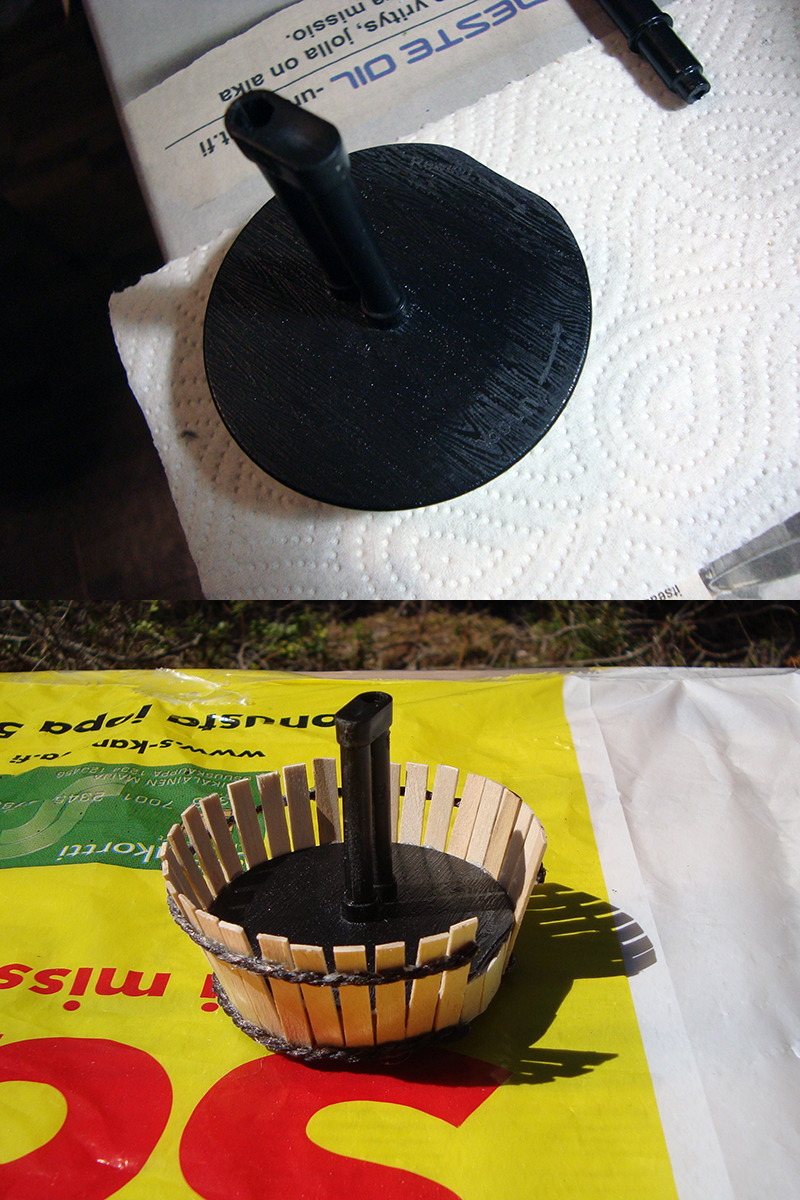
I added planking to the second, larger crow’s nest and added a rope band made out of coarse string around it. While the rope looks nice, it mainly came about simply because making a band around an inverted cone shaped object out of anything else was far too tricky.
Click for a larger version

Click for a larger version

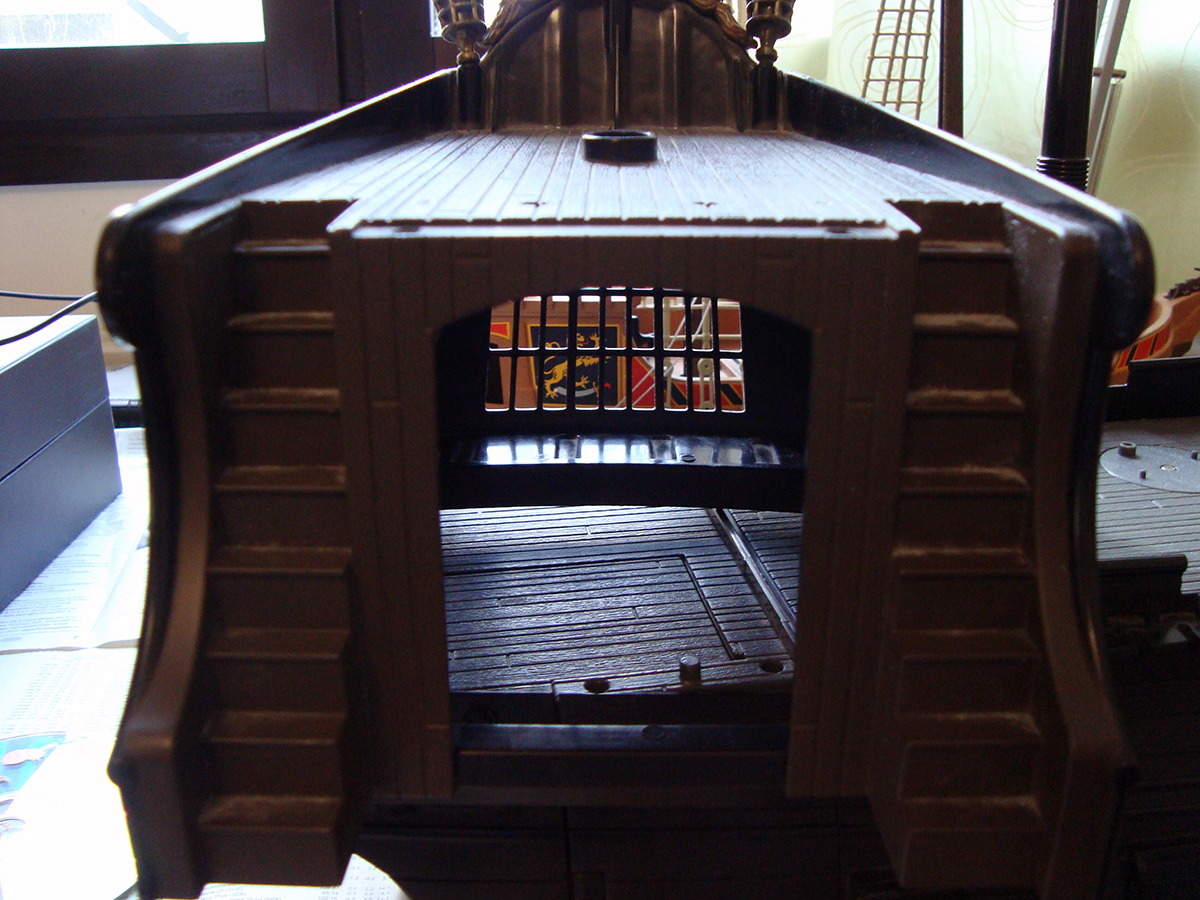
The poop deck is almost finished. I added planking to the blank inside of the aft railing (or whatever it’s called). It took some extra work cutting it into shape, but I think it paid off. I added a swallow decoration above the door from my girlfriend’s broken earring, and decorated the door itself with a plastic shield boss from an old WHFB Empire set. I think it will get a small knocker to finish it off. I messed up a little bit while cutting up the door, so I’ll probably add hinges to the right edge to cover those ragged parts. The wall will also get a lantern from another WHFB set. In the picture you can also see the lovely plank you can extend from the side of the ship. I’ll definitely leave that in place for those Hollywood swashbuckling moments.

Click for a larger version

Click for a larger version

I’ve been putting a fair bit of thought into the painting of the ship, as messing everything up with a failed paintjob after all the work done so far would be heartbreaking. After a lot of consideration I settled on dark brown spray paint, intended for use on metal roofing. It sticks well, covers something wonderful, takes paint and is suitably matte. The decking will probably get a hand-painted lighter, warmer shade and everything will of course be drybrushed later on. Something I was a little concerned about was how well the painting would tie the different elements together. After spraying it all, I could breathe a sigh of relief as it came out as intended, really making the different parts into a whole. At a glance you can’t easily tell the difference between the original plastic ship elements and the coffee stirrer bits.

Click for a larger version

Click for a larger version

Click for a larger version

Click for a larger version

I’m still happy with the project and its progress – and more than a little surprised that it hasn’t come grinding to a halt yet. Watching Black Sails and painting pirates helps, too!

h1

Ship building

May 10, 2015

Work on the ship (see previous post) is progressing at a steady rate, or actually much quicker than I’d anticipated. I’m really starting to get the hang of cutting up coffee stirrers (which I picked up a box of 1000 for 4 EUR) and gluing them in place. I rather feel like a teeny tiny carpenter.

Anyway, here are some pictures of my progress at the moment, with explanations. The picture quality is somewhat poorer than usual, as these are mostly quick progress shots. There is still a lot of work to be done, dremeling, detailing and such.

First up is one of the two crow’s nests. While the original was nice and big, it posed a serious risk of miniatures taking a major fall down to the deck. I remedied this with some stick planking and card. It still needs smoothing over as it was my first attempt, but I think it’s still nice enough and I believe painting will hide the more obvious rough spots. It can easily accommodate a few minis and they’re quite safe from falling.

Click for a larger version

Click for a larger version

Next up is the poop deck (which always makes me snigger, I’m twelve after all). It was originally nice enough, but there was a lot of blank, untextured plastic that I wanted to hide, and the doorway was scaled for larger action figures.

Click for a larger version

Click for a larger version

I covered the doorway area with plasticard and built a new wall out of coffee stirrers. I then chopped up a Playmobil basket for a door and built a doorframe around it. I liked the steps, but added more detail in the form of planking. As this will be a gaming piece, I added little stands made from plasticard and stirrers halfway between each staircase so that models can be placed there to indicate they’re on the stairs.

Click for a larger version

Click for a larger version

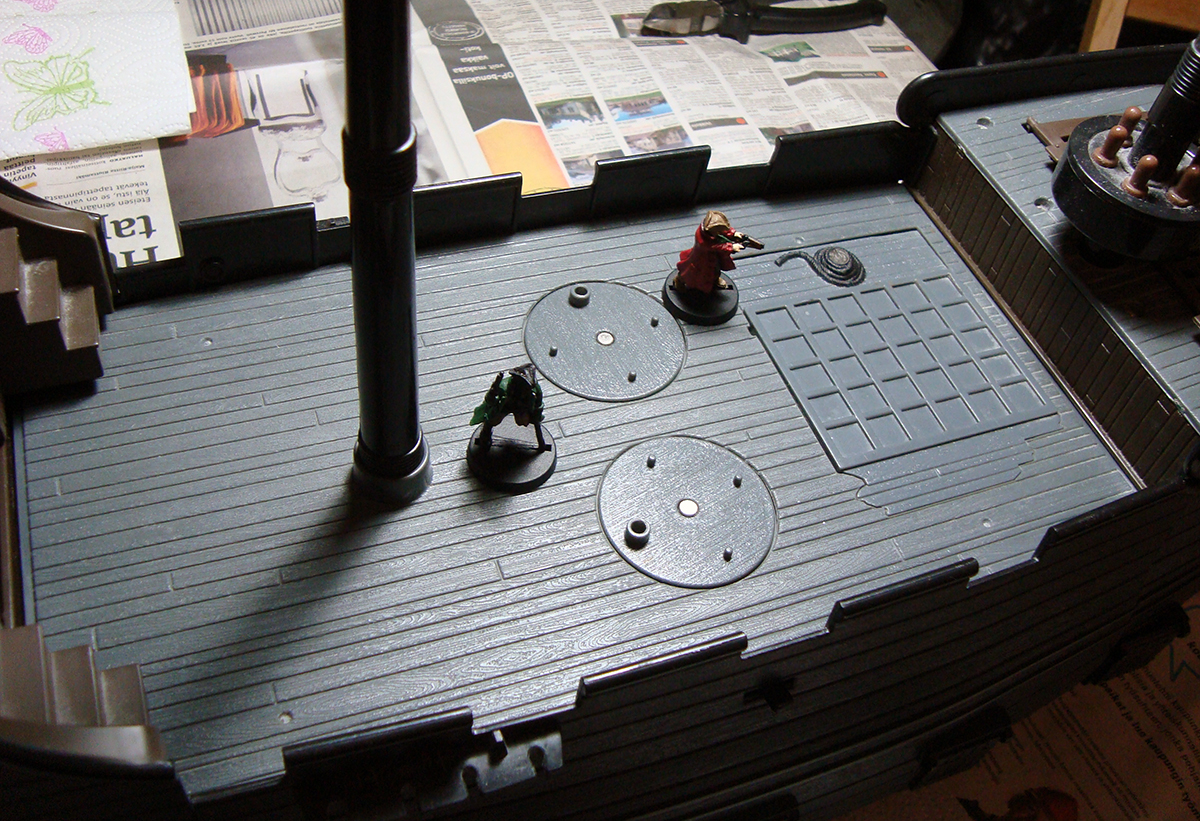
I added planking to the insides of the ship’s railing as well. It was somewhat awful work but looks decent.

Click for a larger version

Click for a larger version

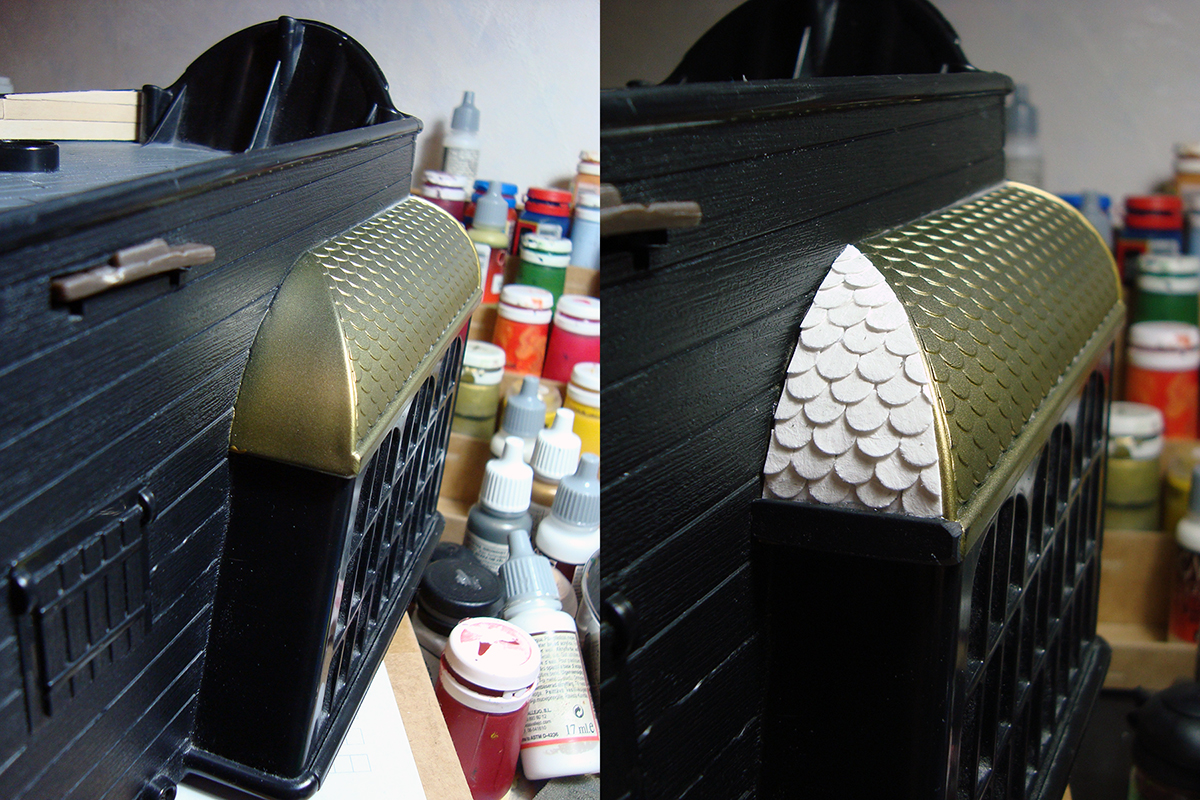
For some reason, one side of the cabin’s outside wall – or rather its roof – was left untextured. Of course, I could’ve left it as it was, but there was a nice fish scale pattern to the roof and all…so of course I had to fix it using a lot of small paper discs from a hole puncher. Silly work, but I think the end result was well worth it. This was the sort of crazy stuff that’s always had me going “who does that?” before.

Click for a larger version

Click for a larger version

There was also an oversized balustrade on the edge of the poop deck. I cut this down to a more suitable size.

Click for a larger version

Click for a larger version

So there’s my progress at the moment. A lot of the hardest and most intricate work is actually already done. There’s still plenty to do, but I’m really motivated at the moment. I love working on this, and the visible progress really helps. I’m also genuinely surprised about how good it actually looks, as my hopes really weren’t that high. It will receive a dark brown paint job, that will hopefully work wonders in hiding some of the gaps between wood and plastic and so on.

Comments are welcome! Next up is the inside of the poop deck as well as cabin wall and door detailing. Actually looking forward to it!

h1

Pirate madness

May 7, 2015

Salute 2015 sparked a huge interest in pirates in me. I was thinking of keeping it very low key – you know, a few packs of miniatures from Black Scorpion and Foundry, some pieces of special terrain, nothing major.

As these things tend to develop, yesterday evening I found myself in possession of a huge, 80 cm long pirate ship. It’s the Black Pearl from the Pirates of the Caribbean movies, it comes from this playset and I got it for 30 EUR off a Finnish auction site. As I said and the pictures show, it’s a massive model, and I’ve no idea how I’m going to store it, but for now I won’t worry about it. Instead I’ll focus on the positive!

There’s so much to love about the ship from a miniature gaming point of view. It’s magnificently scaled for 28mm, it’s nicely textured and has easy access to the ship’s interior. On top of that there are great toy functions such as a small soundboard and even flashing red led lights for the cannon. A piece of the ship’s prow also comes off, which will be a good way to show damage or to depict a beached ship.

The ship will give me plenty of work. While the scale is good for the most part, it’s still intended for large action figures, so I’ll need to make doorways smaller, give the ship a smaller rudder, replace the cannon and so on. Some of the less detailed pieces will need a going over with coffee stirrers and some toy mechanisms will need to be removed. I don’t doubt that it will be a major task, but I’m still looking forward to it! To make my task easier, I’m going for a functional gaming piece and as said, I’m trying to keep many of the toy functions intact. This means I won’t go over the model, puttying over and sculpting every join and gap, nor will I add authentic rigging or anything like that. I know myself, and I want to actually finish this one!

I’ll post updates on the blog as the thing progresses. While I don’t usually show a lot of work in progress stuff, I think that sharing in this case will be good for keeping up the morale (and the stamina). Hopefully this will also provide you with inspiration and entertainment! It goes without saying that feedback, ideas and experiences are warmly welcomed.

I added some quick pics below just to give you an idea of the whole, sorry for the rubbish lighting and setup! All the minis are 28mm.

The ship in all its glory

The ship in all its glory

The rudder has been removed and the railing will be cut down

The rudder has been removed and the railing will be cut down

The crow's nest is large enough for several minis

The crow’s nest is large enough for several minis

Plenty of deck space, the discs will be removed

Plenty of deck space, the discs will be removed


h1

It’s ruined!

July 21, 2014

I’m getting back to painting after one of my hobby-uninspired periods (see this blog post from four years ago). Sort of like exercise, you have to ease yourself into it after a break, so I figured I’d start easy and built a few ruins for my Pacific Rim project. After all, those cities are going to be hit and wrecked, so I’ll need plenty of replacement pieces for destroyed buildings.

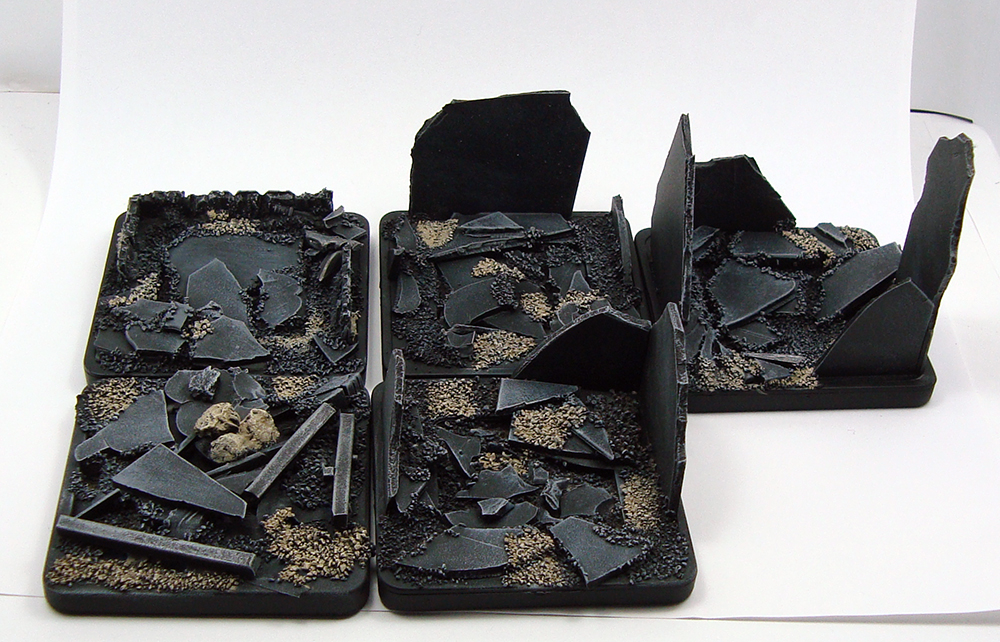
After buying a bunch of Monsterpocalypse buildings and popping them off their bases, I was left with plenty of empty plastic bases which I didn’t feel like throwing away. These provided a great base for ruins. I then simply slapped on rubbish – mainly plasticard cut-offs, sprue pieces, sand and small rocks, undercoated with black and gave the whole thing a quick drybrush treatment. They turned out quite nice, and I wasn’t going for beautiful diorama pieces anyway as they’re rather just glorified tokens.

Click for a larger version

Click for a larger version

The pieces work nicely on the battlefield. Here’s a shot of the kaiju Knifehead with one of the ruins. I like the way the base fits in!

Click for a larger version

Click for a larger version

As and added bonus you can combine them and they work well with 28mm too, which is always a good thing:

Click for a larger version

Click for a larger version

Setting up the mini diorama above prompted me to throw together some ruins, Knifehead and some of my city terrain and smoke pieces to show you what it’s meant to look like eventually:

Click for a larger version

Click for a larger version

As always, all comments welcome!

h1

Morning glory

May 22, 2014

I happened to get up earlier than normal today (6:15 am in fact), and there was such a lovely light in my game room that I snapped a photo of the current state of my Pacific Rim setup. It’s actually an Instagram photo, so I slapped a retro filter on it, and I think it turned out nice. So, here’s a mood piece for you to hopefully enjoy!

“We’ll never forget May 22, when Knifehead hit us around sunrise.”

h1

Seaside fun

April 20, 2014

Every single miniatures project I’ve ever worked on has suffered its share of setbacks. Often these are a result of rash actions instead of careful planning. With my Pacific Rim game board, it just so happened that I decided that the table would look nicer drybrushed. The smart guy that I am, I tried a sample piece first, then a small corner of the table – both yielded nice results. I then meticulously started drybrushing a large board with a small drybrush, got bored, took a bigger brush to it, didn’t bother to wipe the paint off well enough and ended up with one end of the game board looking like someone did some very poor drybrushing on it.

Next came the question of what to do. As the table wasn’t painted to begin with, I figured that to try and paint the area wouldn’t work – I would have to paint the rest of the table to match. For a brief moment I thought that I might simply cut of the messy end, after all foam cuts easily. This however felt a bit too much. Suddenly, a wild idea appeared!

I’d been thinking hard about how to build a seaside on the table. After all, Pacific Rim was all about giant monsters wading out of the sea and into harbours to cause havoc. I had in fact already built a a mock-up of a corner harbour piece out of plasticard and a 1/700 harbour set by Tamiya:

Click for a larger version

Click for a larger version

I wasn’t completely happy with it though. A lot of plasticard was wasted in the design, and the corner design was quite limiting. This got me thinking…

Why not just paint the whole end of the table as seaside? The sea would probably be present in all games anyway, and if I didn’t want it for some reason, I could always cover it up. After a quick round of “is this another stupid, rash idea?”-thinking, I went to work, and in a short time I’d painted the end of the table a lovely sea blue, completely covering up my amateurish drybrushing mess.

coastline

Click for a larger version

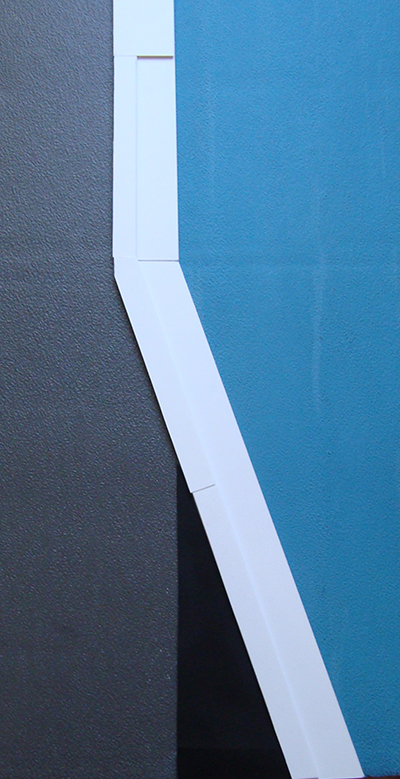
What about the harbour then? With the sea fixed on the table, I figured the harbour just needed to be something to show where the sea ended and to make the razor sharp coastline a bit more interesting. I kept the main idea of my original harbour design, and simply cut out the strips I needed to make the pier. Wanting something more interesting, I went crazy and cut half of the pier in an angle. I was soooo pleased with myself, until I placed it on the waterline and had a wonderful facepalm moment.

Click for a larger version

Click for a larger version

As you may have figured out, I’m not really an engineer. I am however a teacher, and fairly used to improvising fixes for my mistakes. I’ve lately been working with thin mousepads as scenery building material (might do a blog on it), so I just cut out a suitable shape, sprayed it black and voila!

Click for a larger version

Click for a larger version

After I paint it to match the pier, it won’t look out of place at all.

Finally, here’s a shot of the harbour with accessories. I think once it’s painted, it will look mighty lovely. The waterline design also means, that if I want to make a sandy beach for example, I can simply cut up mousepads, paint/flock them and lay them over the waterline. Great success!

Click for a larger version

Click for a larger version

h1

City planning

March 23, 2014

Work continues on my Pacific Rim board. I recently made the base for the game board by first taping the edges of a 60 x 120 cm Finnfoam sheet with blue masking tape, and then gluing wallpaper (see this post) to it. The operation went fairly smoothly – literally – as there were only a few small bubbles left in one part of the sheet. I actually used a rolling pin to smooth it! The key was in the mixture of PVA glue and water, as it needed to be runny enough to make sure no place was left unglued. There are two seams, and they turned out very neat and tidy as well.

Here’s a look at the board itself:

Click for a larger version

Click for a larger version

And with added buildings:

Click for a larger version

Click for a larger version

At this point it looks nice, but still a bit too sterile and clean, so I figured I’d throw in a bit of (WIP) scenics, a few creatures, a tiny tank and some fire and smoke:

Click for a larger version

Click for a larger version

Click for a larger version

Click for a larger version

The buildings are a mix of paper ones from Sarna that I’ve customized, and Monsterpocalypse buildings. They fit together quite nicely, but I still need loads more. I thought of making separate streets, but figured it might be too much of a hassle and create a potentially unnecessary slew of more loose elements. Then again, streets would probably make it look more like a cityscape and less like a grey field. Of course, this is still very much a work in progress thing, but the question of streets keeps bugging me. Do I need them, or will simply adding more variety to the cityscape work? What do you think?


h1

Street life

March 13, 2014

One of my all time greatest challenges when designing an urban board has been the creation of the city streets. Fixed or modular? Plastic, sandpaper, cardboard, felt? Should I paint in road markings? Maybe print out graphics and stick them to something? Seriously, plenty of projects have fallen on the wayside because I haven’t been able to figure out a good way to make all the streets before enthusiasm for the project has waned. As I don’t want my Pacific Rim project to go down that road, something had to be done.

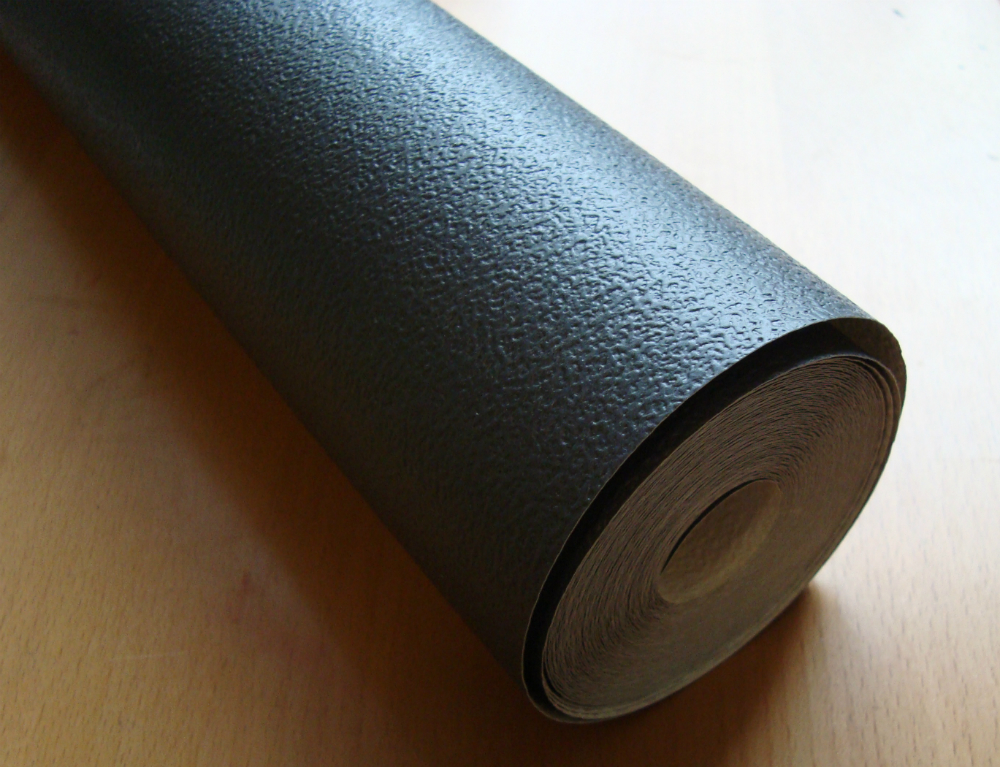
I took a trip down to a hardware store. I had a plan to buy some vinyl flooring mat, if I could find a suitable texture or print. On my way to the flooring section, I happened to pass through the wallpaper section, and there were some pretty nice designs there, including one that had a suitable grey colour and some lovely texturing. I ended up buying a roll, which is approximately 10 times more than I’ll probably ever need in my wargaming life. The texture might be a bit large for 2-3mm scale, but then again pretty much anything apart from sandpaper is. This also allows me to use the wallpaper for building streets for 28mm as well. The wallpaper is surprisingly durable, and any small wear simply shows up as small white spots which don’t look out of place with the texture.

Click for a larger version

Click for a larger version

Now I had a roll of wallpaper looking an awful lot like blacktop, but nothing to attach it to. The smart guy that I am, I marched into the fiberboard section and bought some thin fiberboard. I then got home, cut the fiberboard into two smaller sections, taped the edges, glued some wallpaper on and had a perfect playing field! Or rather, would’ve had if I had remembered a little something called “warping”. As it was, I ended up with a wonky piece of fiberboard, which I simply binned rather than try and spend time to straighten it.

Next I turned to an old favourite of mine, blue insulation foam. I had used this to build a Blood Bowl pitch and most of an Aliens game board (which I really should finish one of these days), so it was a familiar material. I picked up a leftover piece, tried gluing some wallpaper to it with PVA glue and well…

Click for a larger version

Click for a larger version

…it turned out lovely, actually. What did we learn here? Find something that works (blue foam) and stick (wallpaper) to it. With this, I’ve bought a few sheets of Finnfoam which is our local brand of insulation foam. We’ll see what comes out of this! Comments welcome as always.

h1

Size matters

January 23, 2014

So, my recent foray into the world of tiny miniatures continues. Remember a few posts back, when I said I would be doing Pacific Rim in 6mm or so? Oh, silly, silly me!

Why? Let me demonstrate. Below is a picture of one of my kaiju (an old, converted GW tyranid) standing next to a tall building in 6mm scale:

Click for a larger version

Click for a larger version

See? Pathetic. The kaiju and jaegers in Pacific Rim are massive creatures, around a hundred metres or so tall, which should make them about the height of a 30-story building. Since I want to use miniatures that are around 50-60mm tall, that means I need to make the buildings a lot smaller. Which I did.

After playing around with Photoshop and the office printer, I had this:

Click for a larger version

Click for a larger version

Now THAT looks like a kaiju. This puts my project firmly in the 2-3mm scale. Or as I used to refer to it before: “pffffft look at all the silly scales people game in, that’s ridiculous.” There are actually a lot of nice things about this scale. For example, I don’t really need to make any humans, nor any vehicles smaller than trucks. I can also buy airplanes, tanks, ships and the like for a pittance, paint them quickly and scatter them all over the battlefield to be used as thrown weapons or blunt objects. The small scale also means that printed cardstock terrain looks really nice, even if it’s just a collection of simple box shapes.

Also, apologies for the less than stellar photo quality. They’re just quick snaps without any lighting set up!

h1

Hunk of junk

December 21, 2013

I’m currently building up the setup for the next game of Utopia, which means I’m painting and creating yet more generic-ish scenery. In addition to the corky mountains mentioned previously, I’m working on a crashed shuttle.

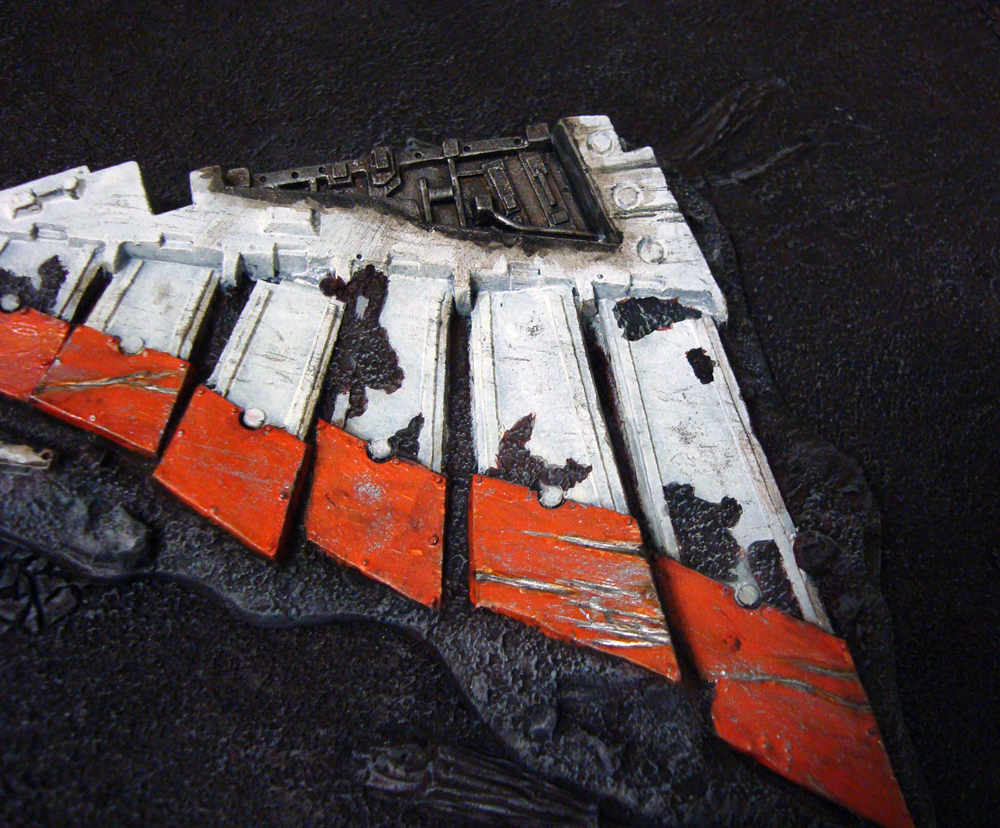
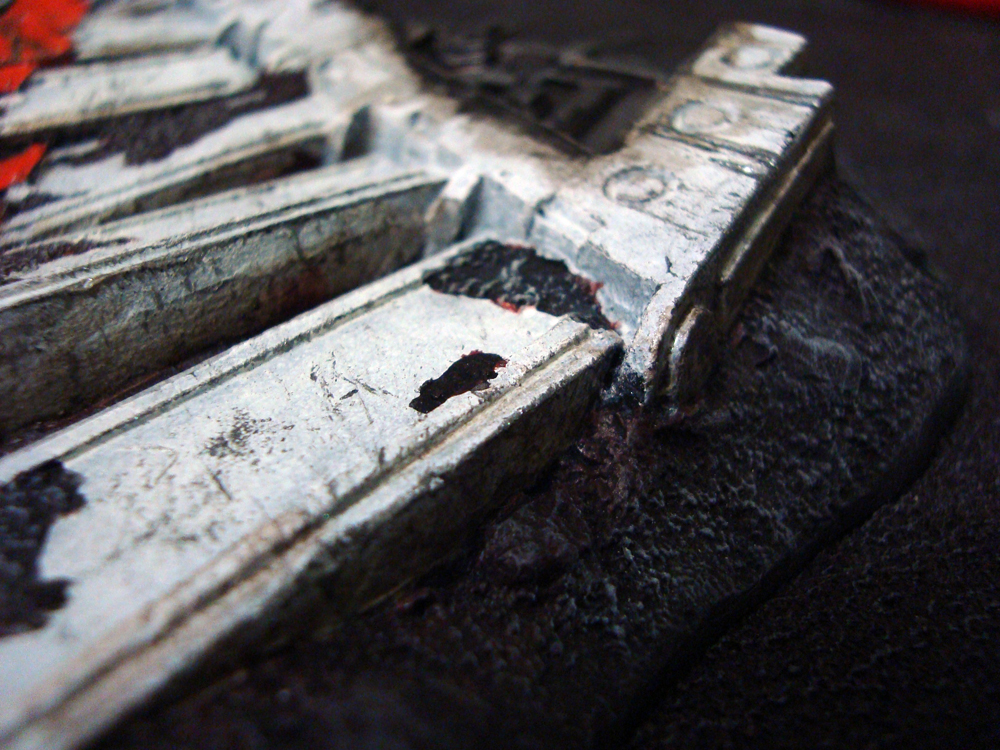
The crashed Aquila lander (shown here painted by the talented Rob Jedi) that was included in the 2004 WH40K box – yes, that was almost ten years ago – has always been one of my favourite terrain pieces, but somehow I just never got one. Once I decided I wanted one, it didn’t take too long to add it to my collection. LAF member Anpu supplied me with one for the mere price of p&p. Bless those Swedes.

I have long wanted to do some weathering, as I think it’s simply dead fun. I had a fun time with the powerloader three years ago, but I haven’t really had anything to work on. I have especially been wanting to paint something white and then weather the hell out of it. This basically decided that the lander would be mostly white. I wanted a nice, brighter colour to contrast with it, and inspired by the lovely District 9 art book (hint: an excellent Christmas present for any scifi enthusiast, if you’re looking for a last minute find) I settled for a nice bright orange.

What then followed was a regular painting of the piece, and the proceeding with the fun – namely the weathering. I used several techniques, mainly drybrushing and bamboo skewer painting. In case you’re not familiar with the latter, it involves snapping a bamboo skewer and using it as a paintbrush. Snapping the skewer results in plenty of uneven bristles pointing in different directions. Dipping those bristles lightly in paint and painting with them results in very natural looking scratches of varying thickness. I also used different washes quite liberally – they can be interpreted as dirt, oil, soot or whatever tickles your fancy.

I painted the base to match my Zuzzy mat, and it’s a nice fit. I’ve still got three more pieces to paint – it’s actually a five-piece kit but the smallest piece is missing. I’m really happy with the way it’s turning out, and it should make a nice centrepiece for the next scenario! Anyway, enough with the talk – time for some pictures. You can click on any photo to open a larger version in a new window.

lander1

lander2

lander3

lander4

lander5

lander6