
Game design thoughts: First steps
April 5, 2026As I mentioned in a previous post, I’ve been steadily putting some work into designing a miniatures game (with the working title Containment) for a while now – you can check out that post to find out why as well as general information about the game! While I’m currently unable to playtest, I have been making a bunch of tweaks to the rules and in general just thinking about what makes a game fun and enjoyable, what doesn’t (Sam Pearson’s game design channel on Youtube has been very inspirational, as has Patrick Todoroff’s blog), and what I want to achieve with this game.
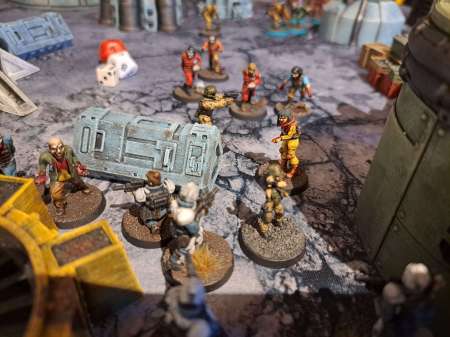
An oddly focused snap from one of my endless number of playtest games
As I felt like writing, I decided to share some of these thoughts. Who knows, this might even turn into a series of posts! In this post, I discuss the concept of the game, its influences, and how they have fed into my design choices in terms of mechanics as well as tone and setting.
Inspiration and first steps
The initial, bare bones version of the game was based on replicating a particular type of scene in “fast zombie” media: the one where there’s a military or police unit trying to contain a rapidly deteriorating, chaotic situation (hence the working title), with zombies – or whatever they’re called in the setting – sprinting in, impacting with the troopers, and bearing them down, only for the troopers to soon rise back up as zombies themselves.
A particular example is this scene in 28 weeks later which I can’t embed as it’s age restricted. It is also noteworthy for the callous approach of the military: at some point it just becomes “shoot everything that moves”. What elements make this scene, and how did they influence design choices when drafting up the basics of the game? Here are three elements relevant to me:
The situation is hectic
This isn’t measured grand strategy, but instead a panicked attempt to contain a situation that is already out of hand. The game needs to reflect this: there has to be a sense of pressure on the player. As I wanted to design a game for enjoyable solo play, I did not want to introduce something like a timer for the player; I want the game to represent a hectic situation, but not for the gaming itself to be hectic. I did, however, want to incorporate elements that convey a hectic feel while also serving the game mechanics-wise.
The central design choice here was that the core gameplay needed to be simple enough to be fast playing. No endless special rules, no calculating hit locations or hit points, no referring to the rules for each action. Also, I wanted there to be the possibility of situations changing rapidly, which led to the initial incorporation of quite a large random element, i.e. dice rolling. A third choice was miniature movement: the infected move faster than the soldiers, so if the soldiers want to do anything else than keep running, the infected will always catch up to them.
The situation is lethal
Tying in with the fast gameplay and genre conventions, death comes at you fast. In gameplay terms this for me meant no protracted hand to hand slogs, minimal tracking of model status, and merciless combat outcomes. In all honesty, the initial version was mainly a simple, brutal soldier annihilation simulator. This would also have design implications down the line, as discussed below.
A big part of this lethality is that soldier casualties quickly become enemies, potentially leading to horrible cascades: a soldier dies, resurrects, attacks the next soldier and so on. This is of course a big part of the zombie genre, especially things like 28 days/weeks later. I introduced two states for soldiers damaged in contact, bitten for “still able to function but will turn soon” and killed for “dead and becoming an enemy shortly”. The zombies, or infected as I soon started calling them, operate more simply. If they are attacked, they either die or they don’t.
The situation is awful
The third takeaway from the scene is more narrative: it’s a genuinely horrific situation with civilians fleeing in panic and getting killed and turned into monsters left and right, and the military electing to abandon all targeting restrictions and simply gunning down everyone, infected and civilian alike. It’s bleak and tragic, and I want some of that in the game. Conceptually, civilians and the potential for civilian casualties were a part of the game from the start.
However: did I want to make a game in which you can kill civilians, and is it overall advisable to include an element like that in a game? How to incorporate such an element without it being very unpleasant for the player, or should it always be unpleasant or repulsive for the player? Considering myself quite sensitive to toy soldier ethics, this prompted a lot of reflection. It also raised questions about the game’s narrative: who are the people who would do so and why? Would and should the game be super, super dark? This was a game I was designing for my own use, but would I actually want to play this game myself?
Putting it into practice
The first versions of the game weren’t great. Or rather, they very much did what I wanted them to do: the infected would run at the soldiers and civilians and the soldiers would get some of them but would eventually be swarmed, often as their companions turned into infected themselves. Combat was indeed very brutal and lethal, and it was hectic.
The problem with this was that it wasn’t very fun. Almost all playtests would turn out the same with some minor variations – every now and then a soldier might survive a bit longer, and rarely the soldiers might even win. It was a somewhat faithful recreation of the scene that inspired it, but…yeah. As anyone who has played Space Hulk knows, brutal combat can be exciting and tense, but it currently wasn’t. Even knowing that it was a very early prototype, things needed to change somehow. More on this in a future post, maybe?
Furthermore, it turned out that shooting civilians was, purely in terms of game mechanics, mostly a moot point: there was no time or reason to do so unless the table had far more civilians than infected, and a setup like that felt much too grim for my tastes, even if faithful to the source material. Now, in the current design stage of the game, a scenario like that is on the cards, but considerably toned down in terms of grimness and, more importantly, better in line with the game’s tone and setting. These two were the main outcomes of early playtesting and I’ll discuss them next.
Making terrible things fun: setting and tone
I knew from the start that in terms of aesthetics I wanted to set my game in a scifi future, largely because that’s my current miniatures kick. I wanted the blue collar kind of scifi in the vein of Alien, Outland, and The Expanse, grounded in our reality, and kind of grubby and gritty instead of the colourful fantasy of Star Wars or the clean utopian visuals of Star Trek. However, combined with the subject matter, this pushed the game in a grim direction: awful things happening in a dirty future.
I’m not a very grim person, nor was I looking for solo play evenings filed with depressing narratives – our world has plenty of those without fiction. The solution? Add a bit of levity, make the horror a little more fun. This would lead to the tone and setting of the game.
As mentioned above, the soldiers controlled by the player would die quite easily and almost inevitably. Now, this usually isn’t very fun in a game: once you have your little troopers, you generally want them to stay alive. If you’ve played Jagged Alliance, XCOM, or Laser Squad, let alone Blood Bowl, it’s not fun when you lose your characters. My first solution was to alleviate this narratively by making the characters…bad.
I had wanted narrative elements from the start, so I decided to introduce personality characteristics for each soldier. These were mostly negative; I wanted characters whose passing wouldn’t really be mourned, so now the roster featured soldiers that were violent, lazy, cruel, vengeful, and 46 other things. This ten led to the game’s narrative core: what kind of organisation would these people seek and find employment in? A private military one, of course. Things just kind of flowed from there. “Violence for profit” was a good match for blue collar scifi with its corporate criticism – think Weyland-Yutani of Alien or the Tyrell Corporation of Blade Runner – and, as I wanted to make the game’s narrative a little less grim, it was a short step to gallows humour and satire from there. The soldiers were no longer soldiers, but operatives.
Dark themes and humour are by no means incompatible, just look at Judge Dredd, Robocop, Starship Troopers (apart from the original book), or even Warhammer 40k. The topic of futuristic private military companies seemed ripe for this kind of thing, allowed me to address some of my frustrations about late stage capitalism and the sanitisation of violence, and provided an important bit of humour and distancing from the dark subject to make it more enjoyable. I now had the setting and tone for my game, written out in my design document as:
a solo miniatures game of managing a futuristic private military company mounting high risk operations against masses of rage-filled infected to generate value for shareholders
Going forward
Now, these were initial steps in the design process taken more than a year ago, and the game has progressed a lot since then. It plays much better and has plenty more variation, there are the seeds of a campaign system, a lot more narrative elements and even the characters are not all horrible! The game is of course far from being finished, but I hope that the write-up above illustrates some of the thinking going into the game and how I’ve approached it.
Oh and what about the civilians? While it hasn’t been written yet, maybe there will be something like an evacuation mission with an acceptable level of ethical personnel reduction while prioritising key company asset security in target selection. Who knows, we’ll see.
If there’s an interest in more posts like this, do let me know, as well as if there are particular topics you’d like to know more about!
 Dawn of the Lead
Leave a comment